Friday, July 11, 2014

Albert Ayler, Spiritual Unity, Anniversary Edition

Yesterday, July 10th, marked the 50th anniversary of the first recording session for Albert Ayler's seminal release, Spiritual Unity. ESP has created a special expanded anniversary edition that includes an extra cut, a version of "Vibrations" that was accidentally included in an early pressing of the disk but otherwise has not been previously available as an integral part of the complete sessions. Now it is. That's a good thing.

I wont re-iterate what I said about the importance of the disk to the world of free jazz. For that you can go to my review article of Tuesday, February 23, 2010 on these pages.

ESP has also put together a full-length narrative The Albert Ayler Story, a download-only set with four-CDs worth of interviews and selected cuts. I've not had a chance to listen to it but you can get it at a limited-time special price if you go over to the ESP site and buy it there. http://espdisk.com/official/catalog/4072.html

Happy listening!

Thursday, July 10, 2014

Rodrigo Amado Motion Trio & Peter Evans, The Freedom Principal

There are pairings of artists in the improvisational avant garde that make very good sense. Some others surprise you with unexpected chemistry. Still others may not exactly have been written in the stars. The recording up today is of the first kind. The gathering of tenor-master Rodrigo Amado and his Motion Trio with trumpet firebrand Peter Evans on The Freedom Principal (No Business NBCD67) results in music as good, as accomplished as one might expect.

Rodrigo and Peter are joined by Motion Trio members Miguel Mira on cello and Gabriel Ferrandini on drums. The results are all you could hope for. Peter Evans brings the fired-up color sound playing and facility that mark him as one of the primo trumpet stars of our time. Rodrigo matches him sound-for-sound and note-for-note when they play in tandem. Each one solos with avant-free authority, with a boil-over-the-pot-lid insistence and dexterity that one would be hard put to better among today's free-jazz, free-improv players. It's about the sound and about the notes here. Both are at the top of their game, which means the sounds and the notes are something very worth hearing.

The cello-drums backwash from Miguel and Gabriel performs its function very nicely--opening up rhythmic, harmonic and sonic possibilities that play off of what Rodrigo and Peter are doing and vice versa.

This is one of those sessions that was meant to be. It comes across as excitingly and artistically as one would hope.

It doesn't flag but you could well salute it. In fact, I do! An indispensable out disk for your collection!

Wednesday, July 9, 2014

Rob Derke & the NY Jazz Quartet, Blue Divide

Rob Derke and the NY Jazz Quartet is sponsored by the non-profit NY JAZZ Initiative. Many of their appearances around NY and their various tours I assume are done under the auspices of the foundation. But even if that weren't so this is a band that plays an advanced version of the music that bears hearing in any event.

Their album Blue Divide (Zoho 201401) makes that clear. Rob Derke has a very vibrant soprano sax tone with much facility and inventive powers on the instrument. He manages to channel the full tone of Bechet and Coltrane in his own way, projects extraordinarily well and has the ability to captivate in his solos. Aruan Ortiz plays an out kind of freebop piano where the chords are thick and complex yet rooted in changes. His solo style continues that feel, whether in block-chord fashion or post-Herbie-Nichols, post-Monk phrasings both asymmetrical and appropriate. Carlo De Rosa plays a foundational bass that expands the tonality in good ways and he can solo with interesting results. Drummer Eric McPherson has an ingrained swing and does what a freebop-context drummer might be expected to do and does it well--play advanced time.

The compositions are by Derke or De Rosa, with the exception of a group imorov and a Herbie Hancock number ("Still Time"). The heads and structures fit the style of the band and give the ear some guideposts for orientation in nice ways. And they are well put together, too.

We have some solidly exceptional modern jazz in these grooves. It's a freebop spectacular from a band that bears close attention.

Monday, July 7, 2014

Francois Carrier, The Russian Concerts Volume 1

The trio of Francois Carrier (alto sax), Michel Lambert (drums) and Alexey Lapin (piano) have been going at it for some time now (type Francois's name in the search box for previous albums), principally via a number of concert appearances of the three in Russia. The 2013 tour is bearing fruit in the release The Russian Concerts Volume 1 (FMR CD367).

Based on this volume one hopes for a good deal more. The first volume finds the three in excellent form. Francois is a dynamo, a force of nature-through-art, playing endless streams of inspired saxophony notable for its exceptionally developed sound fingerprint as well as a liquidity of continuous invention. Michel Lambert's drums are always appropriate, original and sonically alive. Alexey Lapin gives us his far-ranging, freely spontaneous yet incisive pianism at peak levels.

Put these three together these days and you have some spontaneous combustions of great power and poetic art.

This is some free improvisation to define the medium today. This is art! It's also one of their very best! Listen and be convinced.

Friday, July 4, 2014

Sonny Simmons, Leaving Knowledge, Wisdom and Brilliance / Chasing the Bird? 8-CD Set

When the album up today came in the mail I was astounded. "So it's true! Eight CDs of Sonny Simmons!" Yep, that's right! Leaving Knowledge, Wisdom and Brilliance / Chasing the Bird? (Improvising Beings 8-CDs).

So I listened. Damn! This is music that is all over the place with, happily, no peghole to shove it into! The personnel is of course Sonny on cor anglais (English horn) and alto sax, Bruno Gregoire on percussion, Anton Mobin on prepared chambers, AKA_Bondage on prepared guitar, Michel Kristof on electrified Indian instruments and electric guitar, and Julien Palomo on keyboards.

But what music is this? From 2006 to 2014 the recorders were running for sessions where everything went. It straddles the fence between new music. electronic music, ethnic music, free music, East-meets-West music, psychedelic music, and everything in between.

It's way too much to absorb immediately, but you know after listening to everything a couple of times that this is music of a very unbuttoned sort, fascinating and possibly even at times exceptional, beautiful, out, raw and yet virtuous in its refusal to be nailed to a genre wall.

Sonny does not play much in the firey, notey way that established him. But every note counts. And really this is Sonny AND, not just Sonny.

I wont tell you what to think. This one demands your attention. I still plan to go back and listen to each disk thoroughly a bunch of times, because it all kicks you in the tail at first so you must clear your head and hear again.

If you don't like out music that breaks out of the free jazz mode into unknown territory and/or if you don't like electric and acoustic outness combined, this may annoy you. One thing it isn't is self-indulgent. But it IS very much experimental. Everything is meant but there are times when the music is running on intuition. And perhaps not everything is a masterpiece, but how many times is that going to happen on a set like this? It may annoy you, but if that is the case, I say respectfully that you are the problem. The music doesn't elicit that in the least.

So if you are ready to follow Sonny into a new kind of musical abysse, get it! If you know what you want but you don't know exactly what that is, get it. You wont be disappointed, I believe. But you will have plenty of listening work to do. Get it, hammer a Men (and Women) at Work sign onto your door and go to it!

Thursday, July 3, 2014

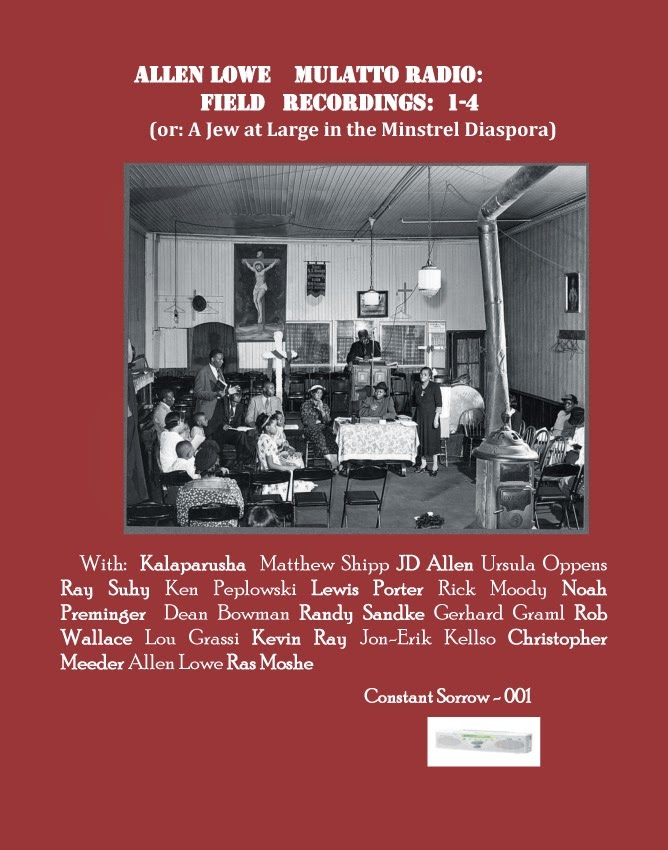
Allen Lowe, Mulatto Radio: Field Recordings 1-4

What do you say about a hugely ambitious and largely very successful project of the breadth and girth of Allen Lowe's Mulatto Radio: Field Recordings 1-4 (Constant Sorrow 101, 4-CDs), which is subtitled A Jew at Large in the Minstrel Diaspora? Even this subtitle would take many pages to unravel, something best done by Allen Lowe himself in a book. In fact the accompanying booklet goes some length in explaining what all that might mean. As with Allen in general it is outspoken and perhaps controversial, one of those things that you can be essentially correct about (assuming that) and open yourself up to a veritable shooting gallery nonetheless, with you as one of the mechanical ducks.

What matters at this point in time for me is the music--and as for that, I hear what is going on in this vast collation and I approve. Not that anybody needs my approval here. Judging things I tend to do almost involuntarily, so there you go. But I suppose that is partly the point of these blogs.

Allen was spurred on by his thoughts to immerse himself in early jazz in its surroundings in not-quite-jazz, roots and what you might term pop from the olden times. He emerges from that exploration with a sequel to his blues set (look him up in the search box for that review).

The 4-CD set contains a wealth of Lowe compositions that start with an early jazz feel and wind their way through Monk and Mingus influences while always keeping an out/avant stance that at times very much comes to the fore, other times is strongly implied. There is plenty of room for improvisation and Allen gets a fair amount of time to show us that his alto playing is something to listen closely to, to pay attention to....Now I may hear everything from Frankie Trumbauer to John Handy, Jackie Mclean, Ornette, and others--but it's Allen's very thorough immersion that puts those influences into a mix that is all his. The compositions do that, too.

And then he has chosen the players here very well. Kalapurusha makes a golden appearance, perhaps his last date before we lost him? The saxes in general get some excellent things going. Ras Moshe sounds great. But close behind him are Noah Preminger and JD Allen. The piano chair is enlivened in some very different ways by the likes of Matthew Shipp, Lewis Porter, and Ursula Oppens, depending what is needed for the piece at hand. Then of all people Ken Peplowski on clarinet, who plays impeccable Peplowski. Ray Suhy gets a chance to play some very interestingly out guitar and on banjo straddles the old-ways and outness. I can't list everybody here but Lou Grassi plays a good role on the drums while Rob Wallace plays a good roll. They both have roles to play and play it they do. Kellso and Sandke do justice to the trumpet requirements and take interesting solos. Then there is a tuba player, Christopher Meeder who gives you the old style and the post-Draper outness too. OK there are others and I am sorry to leave them out, but nobody sounds like they do not belong.

Allen gets a good balance between the compositional and the improvisational--and this is significant fare on both sides. There is the old and the out, again in balance. Imagine Mingus and his Blues and Roots album, only it isn't Mingus and it's right now, like 2013, and it's what Allen creates out of the past and what these excellent players do with it. "My Jelly Roll Soul" did something that can be done again, only subject to what's happened since. And done differently, no less originally. That.

That's what this is.

And after a first, thorough immersion I must say that it's music I want to return to frequently because it's real. There is nothing of the rehash about it. There's no doubt, there isn't any attempt really at literal recreation or some strict form of authenticity. An authenticity of repertoire is not there, and that's what makes it so interesting to hear. Because, face it, the original recordings of the styles treated are where you need to go. Then this becomes comprehensible, but not because it wants to BE that music; but rather it wants to comment on it and further the music of today in the process. (Even if you don't know well the early styles commented on in these "grooves" you still can dig in and dig.) And at the same time I am not saying that all repertoire projects are misguided. There are some great ones that make sense but this is not what this is.

That's what I get out of this. There is no controversy with the music. It's just good music. Is there too much? Only if you don't have any listening time. It requires that, certainly. It's out music that dives deeply into roots but does not wish to become those roots. The compositions and the players are what is happening NOW. And it's a very, very good thing. So, encore.

Wednesday, July 2, 2014

Kali. Z. Fasteau, Piano Rapture, New Works on Piano

Kali. Z. Fasteau, a real, totalized phenomenon in avant jazz circles. . . .She's played with all kinds of seminal avantists, beginning pretty long ago with Donald Rafael Garrett and on from there with a host of heavies. She has more than endured those years, she has flourished as a multi-instrumentalist and leader who coaxes the best from her collaborators and then contributes her own very effectively distinctive playing to boot, whether it's from an array of reeds, vocals, piano, you name it.

She's produced twenty-something albums independently, and regular readers should recognize that I've covered many of them on these pages (type her name in the search box above for that). She never backs down, she always comes through. And her latest, Piano Rapture (Flying Note FNCD 9016), happens to be one of her very best.

It as the title suggests features Kali's piano playing, in solo and duet (and one trio) with some notable improvisors--Kidd Jordan on tenor; L. Mixashawn Rozie on soprano, tenor, flute and djembe; J. D. Parran on alto flute and alto clarinet; and Ron McBee on percussion.

These are free pieces, spontaneously composed by the artists on the spot. Kali's piano playing never sounded better. She cascades, drones, splashes multi-note bursts of sound on the keyboard like paint onto a canvas, and otherwise creatively sounds out very moving and appropriate sound-poems whether in the company of her considerably talented collaborators or by herself.

One of the most moving pieces on the album is "Roy's Wake", a live expression of grief, sorrow and spiritual transcendence on the tragic death of trumpet master Roy Campbell. His sudden passing shocked and deeply saddened the New York jazz community when it came early this year and she movingly expresses that on vocals, electric organ and electric piano while Mixashawn ably seconds the emotion on flute and soprano.

But all of it goes together in one absorbing flow. The relatively short length of each piece and the constantly shifting configurations make listening closely both easy and very rewarding. If it's right to speak of masterpieces only a few days after they have come out, this is surely one of Kali's--a masterpiece in the open-form free-jazz she was been such a vibrant force in and such an important part of for so long. With Kali, technique has always been thoroughly harnessed to the directional momentum of free expression. Never more movingly so than here. Hear.