Friday, May 30, 2014

Ferenc, Gypsy Dream

For those who respond to the Gypsy jazz-Gypsy music revival there is another good one today. Gypsy Dream (Mesa/Blue Moon 2352) features the violin of Ferenc Illenyi, who has the proper passion and liquid approach of the style down very well, very expressively.

He is out front in a small ensemble that owes something to the Reinhardt-Grappelli Hot Club sound. Erich Avinger does some quasi-Django guitar in a nice way and the addition of Andrew Leinhard on piano gives the music a slightly different emphasis. There are various guests throughout the program, with Chris Maresh a constant on acoustic bass.

This is especially a showcase for Ferenc, who has a beautiful sound and a classical-plus-improvisatory prowess. The music varies between Django favorites, Gypsy fusion and the old-style Gypsy sound.

It is quite well done. If you appreciate the Gypsy revival but don't want to stay too firmly in the Hot Club sound, this one ranges much more widely. And you don't feel like you are listening to rehashed Reinhardt-Grappelli as much as experiencing another take on the tradition.

Thursday, May 29, 2014

Trumpets and Drums, Live in Ljubljana, Wooley-Evans-Black-Lytton

There are combinations that hit you straight off, sometimes before you even hear the music. The combination of two modern trumpet masters, Nate Wooley and Peter Evans, with two excellent drummers, Jim Black and Paul Lytton, was one that got my attention before I even played the CD. Trumpets and Drums, they matter-of-factly call themselves. The album Live at Ljubljana (Clean Feed 282) lives up to expectations.

What perhaps straight-off makes for interest is the contrast between the very extroverted, in-your-face, sonically brash outness of Peter Evans and Paul Lytton versus the slightly more considered dash of Nate Wooley and Jim Black. That in a way is a caricature because things never line up that simply with the four concerned. But nevertheless it points out what is a complementary working combination that comes through quite nicely on this set.

Wooley amplifies his trumpet for a wide-ranging sound. Similarly Black manipulates electronics in addition to his drumming. Evans plays a piccolo trumpet along with his usual standard trumpet and Lytton as expected gives us the added colors of extra percussion to his kit.

The music unfolds freely as one long, continuous performance. There are moments of aural experimentation, color building and there are times when the quartet takes it to the stars. A vivid sense of interaction, pacing and keen concentration from all four make it work excellently.

If you know these players you can imagine what the four together can do. They do it here and they do it very, very well. Grab onto this one and head for parts unknown.

Monday, May 26, 2014

Rhys Tivey, No Voice No More

Trumpeter-composer Rhys Tivey may be young (we all were at one time) but he has already formed a particular way of making music, as heard on his quartet disk No Voice No More (self released).

The stage is set for us by the title cut, a pentatonic lament. We have no voice any longer; music will be our voice. From there we go on to three more Tivey numbers, then a cooperative work in five parts by the entire quartet. The music closes out with the standard "My One and Only Love".

The group is a well-matched one. Pianist Jean-Michel Pilc plays an important role fleshing out the harmonic implications of the numbers and soloing in that very developed way of his. Tivey has a matter-of-fact tone on trumpet with a brooding quality in the middle-to-lower register, some brilliance at the top and a very definite feel for phrasing directly and memorably. No, not like Miles, exactly, but pared down to essentials in ways Miles might have appreciated.

The drums-bass rhythm team of Ross Pederson and Sam Minaie has a role to fill in the music and does so with the right feel.

The Tivey numbers stand out as distinctive; the five part "Dream" series is key centered and freely inventive. The foursome come up with a moody stance that is pre-patterned as well as free-wrought, which stands out in ways that stay in the mind. The standard has a Chet Baker-like vocal which perhaps may be classed as inessential. But no matter.

Tivey has determined to strike out on his own. This introduction gives us reason to appreciate his single-mindedness. Pilc sounds great too and the whole band gives you a very special sound that gets your attention and doesn't let go. Keep going, Rhys Tivey! Give this one a listen.

Friday, May 23, 2014

Juhani Aaltonen, To Future Memories

I paid less attention to Finnish tenor jazzman Juhani Aaltonen in previous years than I might have. Then two years ago I heard him in a 2-CD duet with Heikki Sarmanto and it woke me up. I posted on it here on April 30, 2012. Now I am back with another.

This one, To Future Memories (TUM 036), finds Juhani fronting a sextet, with his regular quartet of Iro Haarla (piano and harp), Reino Laine (drums) and Ulf Krokfors (bass) plus the addition of a second bassist, Ville Herrala, and percussionist Tatu Ronkko.

This is a moving program of the sextet playing the music of Antti Hytti, who has a somewhat melancholy way yet also shows the spiritual influence of mature Trane and Pharoah Sanders.

The combination of songs and players works splendidly. Juhani thrives articulating the often balladic melodies and working off of them on tenor, flute and alto flute. Pianist Iro Haarla plays a prominent role in a post-Tyner, post-Alice Coltrane zone. The full rhythm section of two bassists and two drummer-percussionists adds much fullness and color.

The music has a consistently free, rubato flow to it that works well with the compositions.

It may be a bit of a sleeper, but a few close listens convinces you that this is music that is very worthwhile. It is not out to scorch you so much as set a mood that is uncompromisingly free yet contemplative.

I once again am impressed. This is an album to live with over a long period of time. It keeps sounding better to me. Kudos!

Thursday, May 22, 2014

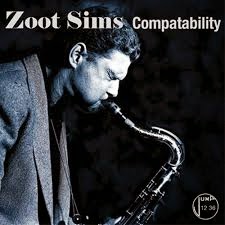
Zoot Sims, Compatability, 1955

First, a confession. For various reasons when I first started seriously listening to jazz I deliberately avoided what was called the "cool school" in jazz and generally the white cats who played it. I read all the various diatribes against the music and took it to heart. Then I listened closely to Miles Davis and his Birth of the Cool sessions. The music moved me very much. Next thing you know I was listening to some of the cool jazz that came after and found I liked much of it.

Now Zoot Sims was never really quite the cool school tenorist, but he was lumped in for various reasons--especially because some of his associations were in the cool zone. It took me a little while but eventually I got to hear Zoot with Al Cohn and with other cats. These many years later I am a confirmed Zootaholic. I don't believe he ever made a bad record, though naturally some are better than others. But Zoot had something and it was just about always with him throughout his long career.

So when Delmark sent me their reissue of Compatability (Jump-Delmark 12 36), a 1955 session for the long defunct Jump label, I took notice.

The album was originally released as a 10-inch LP back then. Sometime in the '70s it apparently came out on a 12-incher with alternate takes. The CD issue we have before us includes 13 cuts with the various alternate takes and we can assume that's the full date.

It was originally put out under the leadership of trumpeter Hall Daniels, who arranged the originals and standards for octet as influenced by the Birth of the Cool contrapuntal style that was quite the thing at the time. The arrangements are good, Hall sounds fine, but Zoot Sims and baritonist Bob Cooper stand out as the best soloists here.

It may not be Zoot's greatest outing but he sounds good and everybody swings along nicely. If you are a Zoot fan you'll eat it up. If not it may not be indispensible. But it's very nice regardless.

Wednesday, May 21, 2014

The Swingle Singers, Weather to Fly

Some groups manage to create music of substance over long periods of time. The vocal unit Swingle Singers first came to the world's attention in the '60s with their patent wordless, swinging versions of baroque classics. That music struck a nerve so much that you heard them virtually everywhere for a time and justifiably so. I believe they garnered five Grammys in that period.

The next recorded performance I heard personally was as a central part of Luciano Berio's Sinfonia. And that was a sign that they could move in many different directions as they saw fit.

They've been together more or less continuously (with a hiatus in the '70s) since 1962. The original members may no longer be with us or have gone on to other things, but the contemporary version of the group shows the same excellence of arrangement and ability, as witnessed by their latest album Weather to Fly (Village Jazz).

The album is a greatly diverse potpourri of contemporary song and shows off the beautiful sound of their voices in tandem and individually. I was surprised to hear them do Chick Corea's well-known "Spain" in a way that refurbished the song in my head and made me appreciate it all over again. The album has much going for it, one thing being unpredictability. This is not cutting-edge or avant but it is excellent in its very own fashion and covers much ground.

I was surprised, in a way, to find that the album is in every way ravishing. It is what it is, but if you like beautiful vocal arrangements well executed you are likely to get with this in a big way. May they continue another 100 years! Recommended.

Tuesday, May 20, 2014

Abdelhai Bennani Trio, Present

The Moroccan tenor saxophonist Abdelhai Bennani has been rather prolific in the past few years, mostly with self-released excursions on the cooperative label JaZt Tapes. He's back with a trio outing on that label, Present (JaZt Tapes 038).

This one has some clout to it thanks in part to the trio format. Benjamin Duboc on double bass and Didier Lasserre, drums, have a long and effective involvement in the free music-avant jazz-free jazz scene and their presence gives some dimension to Abdelhai's saxophony.

Maestro Bennani is a player with a distinct note-swallowing way of phrasing, a very grainy sound at times and a free approach. He sounds completely at ease here and the trio thrives in putting together a very loose and free set. It's something those into the new thing will appreciate, as I did.

To find out more and how to order, go to http://www.janstrom.se/6.-recordings/6.3.-jazt-tapes-6267605.