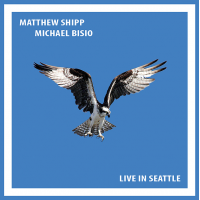
Matthew Shipp and Michael Bisio are some of the very major players these days on the new jazz-avant-rooted-or-whatever-else-you-want-to call-it scene.
You can hear their forays together in excellent incarnations of Matt's trio and of course they each have extensive discographies of great recordings everyone should check out.
Even though it is a truism that the live situation is many times a step above and an ideal setting in which to hear improvised music, you find some relatively few albums that bring the idea home profoundly.
That to me is very much the case on Shipp and Bisio's recent vinyl LP offering Live in Seattle (Arena Jazz AMP 505494).
Seattle, the "Church" to be exact, was just the right setting for the two to make some joyful sounds on April 30, 2015.
Both are in an exuberant playing mood and the audience reinforces and gives them a feedback-loop that enable them to do some of their best playing yet. They run the gamut from abstract yet madly swinging originals with freedom, yet too with a foundation in the heat of tradition. . .
. . . to some standards like "My Funny Valentine" and "Where is the Love" which they remake in their own sound images, and some strictly free blowing, too. In short they cover something of what they are doing typically these days, but they sound especially inspired on this occasion with the open-ended possibilities that just the piano and the contrabass suggest.
They nail it! Michael is burning in pizzicato and bowing modes, more than keeping pace with Matthew's continuing and extraordinary flame of expression. They scale some of the highest heights, do some of their very best playing here.
It reminds you why these two are at the top of the heap today--both individually and in tandem.
In fact I would go so far to say that this is one of a handful of the greatest piano-bass sets recorded in recent times. It is virtually without peer. It has the burning edge of post-hard-bop, the full breadth of freedom, and the ability to bring in compositional elements via standards and Matthew's inspired pieces. They keep the torch wildly and happily surging forth.
Yeah! Grab a copy of this one!
Monday, April 11, 2016
Thursday, April 7, 2016
Jean-Marc Foussat & Jean-Luc Petit, D'Ou Vient La Lumiere!
Today, another invigorating aural outing from Fou Records (FR-CD13), namely Jean-Marc Foussat & Jean-Luc Petit in the epic album . . . D'Ou Vient La Lumiere! It is a sprawling, almost orchestral set with Foussat's live electro-acoustics and Petit's contrabass clarinet, soprano and alto saxes combining for a new-music oriented, free-jazz improvised extravaganza.
What strikes one on first hearing is the nicely realized combination of reeds and electronics, how they work in synchrony and evolve organically with vivid sound panoramas that retain a poetic quality and unfold with a linear thrust. The multi-layered Foussat electro-acoustics form ever-varying dramatic platforms against which Petit's limber and aurally sophisticated reed sonics comment and complement the proceedings creatively and with vivid character.
Each of the four mostly long pieces forms an acoustically advanced poetic whole that has a concerted flow and a conversational agility, a cosmic sound depth, an evenamental thrust, a marked periodicity.
It reminds us that Jean-Marc Foussat is one of the significant leaders and innovators in electro-acoustic improvisational new music today, but also that Jean-luc Petit is a wind-master with a full sound-color pallet and a fertile improvisational imagination.
Get this one for a full-blown journey into the outer realms. There is a consistent realization of long-formed outness that retains your interest and satisfies your craving for the new and futuristic sounds of today! Very recommended.
What strikes one on first hearing is the nicely realized combination of reeds and electronics, how they work in synchrony and evolve organically with vivid sound panoramas that retain a poetic quality and unfold with a linear thrust. The multi-layered Foussat electro-acoustics form ever-varying dramatic platforms against which Petit's limber and aurally sophisticated reed sonics comment and complement the proceedings creatively and with vivid character.
Each of the four mostly long pieces forms an acoustically advanced poetic whole that has a concerted flow and a conversational agility, a cosmic sound depth, an evenamental thrust, a marked periodicity.
It reminds us that Jean-Marc Foussat is one of the significant leaders and innovators in electro-acoustic improvisational new music today, but also that Jean-luc Petit is a wind-master with a full sound-color pallet and a fertile improvisational imagination.
Get this one for a full-blown journey into the outer realms. There is a consistent realization of long-formed outness that retains your interest and satisfies your craving for the new and futuristic sounds of today! Very recommended.
Wednesday, April 6, 2016
Sarah Bernstein Quartet, Still/Free
The musical worlds of Sarah Bernstein are multi-faceted. There can be dark, moody moments, big electric-like sounds, poetic depth and anything in between, but she is always very much herself. On the current release she gives us music in an expanded tonal, beauteous quartet frame. The album is Still/Free (Leo 746). It centers around Sarah's violin of course and features the ever-piquant Kris Davis on piano, plus some first-rate, intelligent rhythm section drive from Stuart Popejoy on electric bass and Ches Smith on drums.
There are seven Bernstein originals that stand out as special and at the same time allow the band to freely swing around them with inimitable soloing from Sarah and Kris, nicely essential solo and group thrusts from Stuart, and world-class time and freedom from Ches.
It shows us in depth Sarah's more ambitiously modern jazz-centered playing and her carefully and effectively wrought modernist compositions in this vein. It establishes that we have something special going on in the way it all flows memorably, gives us some of her very fine, original violin work, essential Kris Davis soloing too and an exciting cohesive band that I hope can continue to play together, gig, make a bigger name for itself.
I love the music. I think you may well feel the same way. Bravo!
There are seven Bernstein originals that stand out as special and at the same time allow the band to freely swing around them with inimitable soloing from Sarah and Kris, nicely essential solo and group thrusts from Stuart, and world-class time and freedom from Ches.
It shows us in depth Sarah's more ambitiously modern jazz-centered playing and her carefully and effectively wrought modernist compositions in this vein. It establishes that we have something special going on in the way it all flows memorably, gives us some of her very fine, original violin work, essential Kris Davis soloing too and an exciting cohesive band that I hope can continue to play together, gig, make a bigger name for itself.
I love the music. I think you may well feel the same way. Bravo!
Tuesday, April 5, 2016
Grego and a Few Words on His New Albums "Osirus in Orion I & II"
Grego here. My seventh and eighth albums, Osirus in Orion I & II (Ruby Flower), are now out and available on Amazon http://www.amazon.com/s/ref=nb_sb_noss_2?url=search-alias%3Daps&field-keywords=Grego+Applegate+Edwards As usual I occupy a little blog space to talk about them. A mock interview format seems like (as before) a way to break it up, so here goes.
Gapplegate: So what is going on with your new volumes Osirus in Orion I & II?
Grego: I wanted to gather together the more interesting of the off-the-cuff tracks I've captured while making some of the more dense and layered music that I've put out on my previous albums. The tracks have been culled from some of the first things I did in the current studio setting and then from various points later on. I had been working with the audience-free avant rock improv unit The Yodlers for more than a decade when 9-11 jarred my sensibilities and made me realize that there were other musical mountains I needed to climb, or at least try to start another climb or two. So I bought a bunch of new musical instruments (financed through a very modest inheritance), put together a recording studio bit by bit and started working on some ideas. The Yodlers operated on a principal of absolute freedom and spontaneity and that was cool. It involved a group dynamic that was often interesting but I was starting to think of different ways to get out to different places and I wanted to work on them a little. So I started with simple capabilities, two-track live and eventually four-track. I mostly just turned on the recorders at first and let something happen. Then eventually I got a much more sophisticated capability that let me compose and arrange for many instruments. But those first spontaneous moments had something too and I later returned to that from time to time to see what would come out. Osirus in Orion chooses some of the very first basement music and then from the later solo things that I thought had interest.
Gapplegate: So how does that work with the cosmos-themed titles?
Grego: Well, all of it has a more or less spacey outlook. There are solo moments for drums alone, vibes, piano and synth keys, guitar with or without beat box, some oriented to a rock crudity, punk-like, some taking inspiration from my surf-music oriented youth, a little in the Rypdal mode, others "free" in the improvisatory style, having in effect a kind of tributory relationship with Cecil Taylor or Sun Ra, but all basically initially or wholly spontaneous and worked into form (in the virtual quartets) or left as a one-take expression of some improvisatory idea. But they strove, all of them, to exit the mundane space and enter into something more outward-reaching. So the space theme worked for me.
Gapplegate: Do you see yourself as an improvisor-instrumentalist? A composer? A sound artist?
Grego: The thing about doing all this music by myself in my basement, I do not see myself at all. I am just a conduit without audience (for these), without a clearly conscious aim, someone who plays a fair number of instruments but not as a "guitarist" a "keyboardist," or what-have-you. I was mostly known as a drummer/percussionist in my active gigging days, though the piano was an important part of my musical life too and the guitar and I have had an attraction to each other from my youth and that never fades. I play some bass guitar here as well but that's in the quartet numbers. It's a matter of loving the sounds, trying to make them happen, getting a facility of some sort but then trying for a musical result that interests me. I play "composer's" instruments, maybe. The thing is I don't really care how people see me as long as my music gets to them on some level. And the idea of sitting down and making some music for yourself has always been key to me. If that music can be heard by others and they get something, that's great, but originally the music on these two CDs was just for myself.
Gapplegate: Do you envision yourself playing with others again? In public?
Grego: Of course. But that wasn't my ultimate aim in the music on these albums. It was making something of the moment, of my life as it was at any point, to put it into sound. Nothing at all pretentious. I just went and DID. This stuff is very personal, sometimes very raw, but absolutely sincere, so much so that I have a certain misgiving putting it out at all, like sharing letters to a lover or something. But ultimately I hoped it might be of interest to folks, some of them, so I put it together and there we are.
Gapplegate: So this is more of your "live" self, playing to yourself?
Grego: I guess so, yes. The virtual quartet pieces are four-times live, the rest are all in real-time, like when I am playing a sustain synth set of chords with my right hand and responding on seven string as a real time sort of dialog, or when I am doing some music against a beat box, starting with guitar, switching to drums, or just simply playing an instrument by itself.
Gapplegate: Do you plan on doing more of this solo work?
Grego: No plans to, no. It's basically a one-time set of musical snapshots that captures the time spent in the first decade or so of the new millennium here outside of NYC. The times may have been rough, and sometimes there was a sheer joy in making music, but it all gets in there somehow. I hope it gives pleasure.
Gapplegate: OK, then. What's next?
Grego: There is a virtual orchestra rock post-Milesian thing, "Expansion," then an album of folk song psychedelia arrangements, all coming soon. After that we'll see.
Aarhus Jazz Orchestra Presents Lars Moller's ReWrite of Spring, Featuring David Liebman and Marilyn Mazur
There have been a few jazz rethinkings of Stravinsky's landmark "Rite of Spring" but none so thoroughly reworked and rethought as Lars Moller's ReWrite of Spring (DaCapo 8.226117-18) which fills two CDs with a studio version and a live version. The Aarhus Jazz Orchestra plays with a marvelous discipline and artistry under Lars' conductorship. David Liebman's soprano and Marilyn Mazur's percussion take on some prominent roles and they rise to the occasion wonderfully.
17 fine musicians make up the Aarhus outfit. They are put through their paces with great results.
The composition ultimately is the main premise here, understandably. Moller is a jazz composer of genuine talent. Whether you know the original "Rite" like the back of your hand or not much at all, the music speaks for itself here in all its throaty complexity. Those who know the Stravinsky will hear motifs emerging from the carpet of big band sounds and so have an inside track of what Moller is up to. But then the results are so engaging in a modern vein that those with big ears will doubtless not fail to appreciate what is going on regardless.
The live version has a bit more time (ten minutes, to be exact) for solo space that Liebman and Mazur take advantage of with the excellence one expects from them.
In the end the idea of a complete "ReWrite" of the "Rite" is a good one. You in effect get a wholly new, wholly modern jazz oriented work that transposes the excitement of the original to a present-day big band context. Moller knows his band, the instrumentation and the players involved well and scores the music with a post-Evans insight into the varied colors, textures and potential power he has at his disposal.
It is a triumph for all, nearly breathtaking in its strength and breadth, performed with magnificance and filled with compositional brilliance.
Strongly recommended!
17 fine musicians make up the Aarhus outfit. They are put through their paces with great results.
The composition ultimately is the main premise here, understandably. Moller is a jazz composer of genuine talent. Whether you know the original "Rite" like the back of your hand or not much at all, the music speaks for itself here in all its throaty complexity. Those who know the Stravinsky will hear motifs emerging from the carpet of big band sounds and so have an inside track of what Moller is up to. But then the results are so engaging in a modern vein that those with big ears will doubtless not fail to appreciate what is going on regardless.
The live version has a bit more time (ten minutes, to be exact) for solo space that Liebman and Mazur take advantage of with the excellence one expects from them.
In the end the idea of a complete "ReWrite" of the "Rite" is a good one. You in effect get a wholly new, wholly modern jazz oriented work that transposes the excitement of the original to a present-day big band context. Moller knows his band, the instrumentation and the players involved well and scores the music with a post-Evans insight into the varied colors, textures and potential power he has at his disposal.
It is a triumph for all, nearly breathtaking in its strength and breadth, performed with magnificance and filled with compositional brilliance.
Strongly recommended!
Monday, April 4, 2016
William Parker, Stan's Hat Flapping in the Wind, 19 Songs Performed by Lisa Sokolov and Cooper-Moore
We get a special window on the more lyrical and intimate side of jazz composer and leading artist William Parker in his new CD Stan's Hat Flapping in the Wind (Centering 1012), as performed by vocalist Lisa Sokolov and pianist Cooper-Moore.
There is a fine balance on these songs between the poetic and the soulful, the reflective and the testificatory, the direct and the impressionistic, the spiritual and the it-ness of existence. There are nods, tributes to some greats now sadly gone, Mahalia, Ornette Coleman, Butch Morris, Jeanne Lee, David S. Ware, Miguel Pinero.
The music begins in effect with William's remembered images of Daniel Carter and his wife Marilyn Sontag coming towards him at Washington Square Park with Marilyn's felt hat flapping about in the wind and yet another occasion with film maker Stan Brakhage doing the same. Both were preludes and presages of artful events about to take place, and somehow the images allow and help us realize a set of characters coming "in and out singing songs that speak about dancing, singing that acknowledges the holiness of the spirit world and the acceptance of mysteries, and songs in praise of song," in William's words from the liners.
And so all 19 songs move us variously as realizations of what the spirit brings to us. The songs range from proudly declarative, pensively thoughtful, affirming and transcending resignation, on the actual and artful capturing of the reality of life and death.
Lisa Sokolov gives us a hugely soulful and dramatically alive singing of the songs. Cooper-Moore gives us a full range of moods corresponding to the songs at hand, complementing the vocal nuances and the lyric content with a fully fleshed-out pianism.
The wealth of beauty contained in the songs defy any attempts at simplification. Each is like a spring flower, unique in itself and ultimately beyond words, yet filled with poetic saying. Blooming like a momentary impression that vividly captures all, like those hats flapping in the wind, pregnant with themselves and containing the germination of all that is, life and its finite duration and the realization of what has been in every now we are to live.
That is how I feel after hearing these 19 significant pieces of William Parker, each a part of himself yet detached and letting the wind blow through them as sound-in-air.
They have a healing quality. They need to be heard. Hear them!
There is a fine balance on these songs between the poetic and the soulful, the reflective and the testificatory, the direct and the impressionistic, the spiritual and the it-ness of existence. There are nods, tributes to some greats now sadly gone, Mahalia, Ornette Coleman, Butch Morris, Jeanne Lee, David S. Ware, Miguel Pinero.
The music begins in effect with William's remembered images of Daniel Carter and his wife Marilyn Sontag coming towards him at Washington Square Park with Marilyn's felt hat flapping about in the wind and yet another occasion with film maker Stan Brakhage doing the same. Both were preludes and presages of artful events about to take place, and somehow the images allow and help us realize a set of characters coming "in and out singing songs that speak about dancing, singing that acknowledges the holiness of the spirit world and the acceptance of mysteries, and songs in praise of song," in William's words from the liners.
And so all 19 songs move us variously as realizations of what the spirit brings to us. The songs range from proudly declarative, pensively thoughtful, affirming and transcending resignation, on the actual and artful capturing of the reality of life and death.
Lisa Sokolov gives us a hugely soulful and dramatically alive singing of the songs. Cooper-Moore gives us a full range of moods corresponding to the songs at hand, complementing the vocal nuances and the lyric content with a fully fleshed-out pianism.
The wealth of beauty contained in the songs defy any attempts at simplification. Each is like a spring flower, unique in itself and ultimately beyond words, yet filled with poetic saying. Blooming like a momentary impression that vividly captures all, like those hats flapping in the wind, pregnant with themselves and containing the germination of all that is, life and its finite duration and the realization of what has been in every now we are to live.
That is how I feel after hearing these 19 significant pieces of William Parker, each a part of himself yet detached and letting the wind blow through them as sound-in-air.
They have a healing quality. They need to be heard. Hear them!
Friday, April 1, 2016
Matchbox, Jorrit Dijkstra, Pandelis Karayorgis, Nate McBride, Curt Newton
From up there in Cambridge, Massachusetts, we get more of the worthy musical semaphores and full-phores of a modern avant jazz kind that altoist Jorrit Dijkstra and pianist Pandelis Karayorgis have been supplying us with on their Driff label.
The one on tap for consideration today is a nicely expressive quartet date--Jorrit, Pandelis, plus Nate McBride on bass and Curt Newton on drums. The album is called Matchbox (Driff 1501).
This is a quartet that knows where it is going. The compositions, alternately by Dijkstra and Karayorgis, extend the legacy of Monk, Mingus and Dolphy with originality and both swinging and free-flowing architectonics of a pronouncedly geo-angular penchant. Every piece has a pronounced feel to it which the improvisations expand and capture in the jazz moment.
Jorrit opens up the color possibilities with the lyricon and a synth, and that sounds as right as the all-acoustic numbers. Curt Newton drums with smarts, swing and color. Nate McBride shows his formidable flexibility and ability to get where he needs to to make everything work. Then of course Jorrit and Pandelis each are artistic personages with their own special aural footprint, originals in full bloom here.
In the ten numbers featured on Matchbox we get an abundance of inspired avant jazz, some of the best around these days. There is an easy familiarity of the four that comes with a long period of interaction and so we get a chance to hear a seasoned foursome that can anticipate what everybody is doing and follow suit with their own corresponding conversational voice.
This one is a definite treat to hear. Outstanding quartectonics!
The one on tap for consideration today is a nicely expressive quartet date--Jorrit, Pandelis, plus Nate McBride on bass and Curt Newton on drums. The album is called Matchbox (Driff 1501).
This is a quartet that knows where it is going. The compositions, alternately by Dijkstra and Karayorgis, extend the legacy of Monk, Mingus and Dolphy with originality and both swinging and free-flowing architectonics of a pronouncedly geo-angular penchant. Every piece has a pronounced feel to it which the improvisations expand and capture in the jazz moment.
Jorrit opens up the color possibilities with the lyricon and a synth, and that sounds as right as the all-acoustic numbers. Curt Newton drums with smarts, swing and color. Nate McBride shows his formidable flexibility and ability to get where he needs to to make everything work. Then of course Jorrit and Pandelis each are artistic personages with their own special aural footprint, originals in full bloom here.
In the ten numbers featured on Matchbox we get an abundance of inspired avant jazz, some of the best around these days. There is an easy familiarity of the four that comes with a long period of interaction and so we get a chance to hear a seasoned foursome that can anticipate what everybody is doing and follow suit with their own corresponding conversational voice.
This one is a definite treat to hear. Outstanding quartectonics!
Subscribe to:
Posts (Atom)


