Showing posts with label improv. Show all posts

Thursday, June 16, 2022

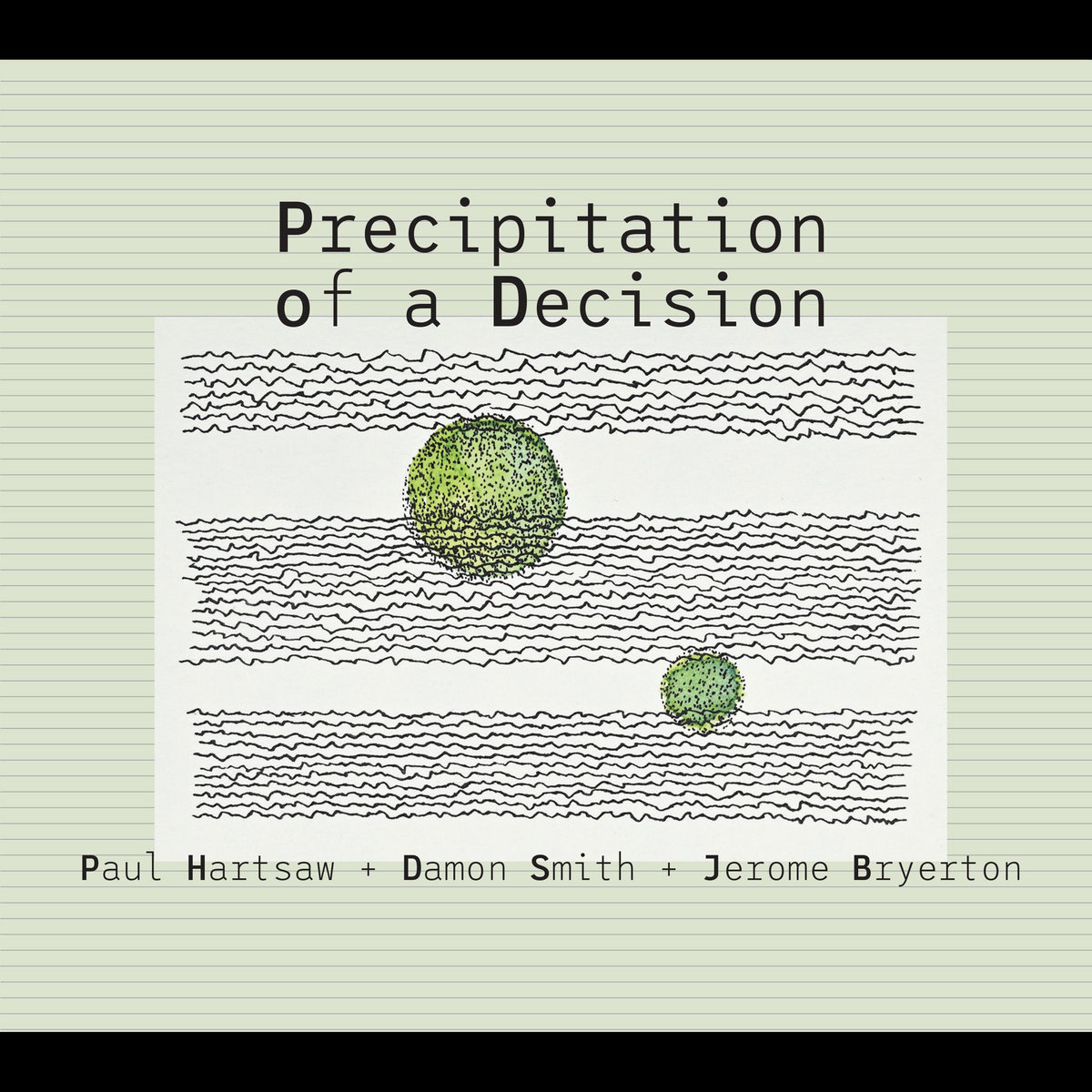
Precipitation of A Decision, The Ride on the 8 of Infinity, Paul Hartsaw, Damon Smith, Jerome Bryerton


There is something about music that is as good as one hoped it would be. It is reassuring? Consoling? There is also something interesting about how Free Improvisation can come to transcend the idea of the totally spontaneous when you hear it a fair number of times and it starts to make a meta-sense to you--in other words you understand it as a kind of deliberate form even though it is "off the cuff." I must report in, gladly,  that the album at hand today gives me both satisfactions. 

Precipitation of a Decision, The Ride on the 8 of Infinity (Balance Point Acoustics BPA 2CD3)  combines pn two CDs a 2008 session (Ride) with one from 2021 (Precipitation). Ride features Paul Hartsaw on soprano and tenor sax and Damon Smith on contrabass. Precipitation has Hartsaw on tenor only along with Damon Smith on contrabass and Jerome Bryerton on drums.

Both Paul Hartsaw and Damon Smith are artists I have been hearing and appreciating for some time. (Look up both in the search indexes both here and on the Gapplegate Guitar and Bass Blog for earlier reviews of albums by both artists.)

The trio album is especially invigorating, with wonderful three-way interfaces of dynamic freedom. The duo disk has especially intimate dialogues, not as full-out blowing energy exactly,  but then really quite subtle and absorbing in a slightly more esoteric way. Drummer Bryerton sounds lucid and open in the trio session. And the three get more dynamic and energetic at times.

It is all told some of the finest free jazz albums of the year thus far. It is after a few listens centered on the world that the players occupy and respond to, it goes perhaps without saying. But of course it is not THAT they respond so much as HOW they respond, that makes this special.

This one will certainly appeal to the Free Improvisation aficionados out there, as it is a specially fine example. It might also serve to introduce nicely those not familiar with the genre. Bravo!

Thursday, July 10, 2014

Rodrigo Amado Motion Trio & Peter Evans, The Freedom Principal

There are pairings of artists in the improvisational avant garde that make very good sense. Some others surprise you with unexpected chemistry. Still others may not exactly have been written in the stars. The recording up today is of the first kind. The gathering of tenor-master Rodrigo Amado and his Motion Trio with trumpet firebrand Peter Evans on The Freedom Principal (No Business NBCD67) results in music as good, as accomplished as one might expect.

Rodrigo and Peter are joined by Motion Trio members Miguel Mira on cello and Gabriel Ferrandini on drums. The results are all you could hope for. Peter Evans brings the fired-up color sound playing and facility that mark him as one of the primo trumpet stars of our time. Rodrigo matches him sound-for-sound and note-for-note when they play in tandem. Each one solos with avant-free authority, with a boil-over-the-pot-lid insistence and dexterity that one would be hard put to better among today's free-jazz, free-improv players. It's about the sound and about the notes here. Both are at the top of their game, which means the sounds and the notes are something very worth hearing.

The cello-drums backwash from Miguel and Gabriel performs its function very nicely--opening up rhythmic, harmonic and sonic possibilities that play off of what Rodrigo and Peter are doing and vice versa.

This is one of those sessions that was meant to be. It comes across as excitingly and artistically as one would hope.

It doesn't flag but you could well salute it. In fact, I do! An indispensable out disk for your collection!

Friday, December 16, 2011

Travis Laplante, "Heart Protector" for Solo Tenor Saxophone


In some ways the solo saxophone set is the hardest genre for the music writer to evaluate. It is by nature a very personal statement, one man (or woman) alone with the instrument, seeking to make some sort of impactful utterance. Aside from downright incompetence, what factors does one consider when listening? Who is to say that so-and-so should have done this or that, instead of what he did?

Travis Laplante's Heart Protector (Skirl 018) brought such thoughts to mind as I listened. And it was only after I had absorbed the full impact of the entire set repeatedly that a clear picture came to mind of what I was hearing.

There is no question of incompetence here. Everything shows facility and control. It's far from bebop. Now most solo sax disks are, so that isn't something that needs to detain the listener.

There is a formal kind of progression in the five parts on the disk. Laplante goes from harmonics to rapid, two-note alternations with overblowing and underblowing changing the pitch and timbre shape; to overblowing outness a la Ayler; falsetto tones and harmonics; rapid, repeated three- and four-note figurations, again over and underblown to produce variations in harmonics and pitch, evantually modulating to other note-cell structures; and finally, a somewhat pure-toned rumination on a key-centered melodic figure.

In the course of all this Laplante has in common with numerous other modern saxophonists the extension of the sound of the instrument in a jazz vein and an expressive tumultuousness.

Is he better than others doing this? No. But in the end you feel that he has put together a kind of sonic suite that after you've heard it a few times hangs together and stands out in the mind as more than a standard blow-out might in certain hands. It all fits. And it is not fashioned of cliches. So we have something well-conceived. There are only 30 minutes of music, mind you, as a vinyl release. But there is nothing superfluous here, either. It's available as a CD too.

Tuesday, December 6, 2011

Daunik Lazro, "Some Other Zongs," Solo Baritone Sax Live at Europa Jazz Festival 2011


Ten years ago Daunik Lazro did a solo baritone sax recording, Zong Book. I've never heard it but I have been listening to his new one, Some Other Zongs (Ayler 123). It's a sequel solo bari session recorded live at Europa Jazz Festival, Paris, in February 2011.

Daunik utilizes the baritone's flexible and rich timbre possibilities to create poems of improvised sounds. I wont say "like David Mott," because it is not quite, but both artists have very good control over their instrument and complement it with a fertile imagination.

At 44:59 total length the CD does not overstay its welcome and that gives Daunik L. just the right amount of time to say something that is not uninteresting.

You like the sound of a free-form baritone sax? Get this. Get a David Mott solo CD too while you are at it, if you can. Then crank up your music unit a bit and dig the harmonics, overtones and grainy bite of the instrument in capable hands.

Thursday, December 1, 2011

Side A, "A New Margin": Vandermark, Wiik, Taylor Get it Going


Side A? A trio of Ken Vandermark, reeds, Havard Wiik, piano, Chad Taylor, drums. Their A New Margin (Clean Feed 235) seems like the right combination of inspired improvisation, appropriate and memorable composition, and collective spark.

The compositional assignments are equally divided among the three, which makes sense since Ken and Chad do good work, and it turns out Havard does too.

"Boxer" is a fitting and stirring beginning with a sort of modified ostinato that is in a lineage to Dolphy's "Hat and Beard". Ken sounds like he is on baritone for this (and indeed for others as well, though the album jacket credits him as playing tenor and clarinet only) and he and Chad do some lively improvising. "What Is Is" switches to another interesting ostinato, and they groove on in a free rock zone, taking it out.

"Trued Right" has a chordal-melodic line in the piano that swings along well with the addition of Chad's drums. Ken's clarinet puts forth some goodly improvs.

That's a sample of what you hear. It is not all ostinato-based. There are balladic outnesses, postboppishness and some pointilistic, whole group improv phrasings too, among other things. Chad Taylor comes through with the excellent drumming he is known for. He can swing strongly in ways that reference the tradition but do so with originality. And he can get into a freetime that spurs the group on but also has a musical language going that shows you Chad the musician, the musical drummer. Havard Wiik articulates structure often enough, playing a centering role in the trio. His solos have some of the motor outness of Cecil, and the hunt-and-peck aspect of Havard's style has a kind of discursive logic--like he is saying something from A to B, B to C, sequentially. Ken V. is as always highly articulate, fired up, a person who pays as much attention to the sound he gets as to the notes he plays.

This is measured out avantness, music that has been thought through, that uses ostinato and other repetitive compositional devices in contrast with freely firey variables and/or compositionally lengthier phrasing. It is pretty tightly sequenced episodically. That makes for some exciting listening.

It's an important outing. Chad and Ken hit it off together very well here, as is no surprise, and Havard puts his piano at the center in ways that make things click. Compositional-improvisational inspiration is in no short supply throughout. One of the best out small group excursions of the year!

Monday, November 15, 2010

Eli Keszler Combines Improv and the Compositional on "Oxtirn"


Eli Keszler has a new LP of his music. It's on ESP and sounds like it should be (in the positive sense). Keszler plays drums, percussion, prepared piano, guitar and a number of prepared found objects. He is joined by a brassman, a clarinetist and a second prepared pianist for the two longish pieces featured on Oxtirn (ESP 4061). The LP is a limited edition; a digital download includes one bonus track.

And what of the music? It is a blast of sound, thickly textured. The first piece sounds like an acoustic version of one of Xenakis' classic electro-acoustic pieces. Dense, rapidly articulated metallic percussion sounds contrast with long, bowed-sheet metal envelopes.

The second piece is less dense but once again creates the impression of altered sounds even though this is music made "live."

It's a fascinating set of sound poems. If you like MEV and AMM, this one will give you something similar yet distinctive.

Thursday, October 14, 2010

Daniel Levin Quartet's Fifth: Bacalhau


Chamber jazz is alive and well. Cellist Daniel Levin's Quartet embodies the new sensibilities to be heard and felt on multiple levels. That can be seen most particularly in their new fifth CD, Bachalhau (Clean Feed 195).

The quartet consists of Levin on cello, Nate Wooley on trumpet, Peter Bitenc on contrabass and Matt Moran on vibes. It's a sonorously well-wrought ensemble. Each instrument has its aural space (well recorded here live) and they blend in ways that give you a musical landscape that expands into the distance but is dotted with events that make the distance seem smaller, somehow.

The first two pieces show the vital contrasts the group can achieve. "Looken" has a post-bop-to-free orientation, with a strictly modern-jazz sounding head and wide ranging avant-before-and-beyond solos to a walking bass. "Duo Nate and Matt" gives you a more improv-oriented new music side as Matt bows his vibraphone keys and Nate sustains the grainy lowest registers of his trumpet.

The music on this fine CD continually traverses the territory between those two spectrum ends. And with the improvisatory talents of the quartet members always out front, they do it in ways that never seem contrived or tentative.

Levin-Wooley-Bitenc-Moran are making important music. It's well worth hearing.

Wednesday, October 13, 2010

Pianist Pandelis Karayorgis Plays "Caramelula"


Boston-based Pandelis Karayorgis has been the subject of several review postings on my blogs. Today there is yet another one. I suppose you can tell I like what he is doing! This one is an Ayler Download-Only recording, which goes for a good price. Caramelula (Ayler Download 078) situates Pandelis in a good trio setting, with Nate McBride (bass) and Randy Peterson (drums).

Caramelula provides nearly an hour of the trio in action, playing Karayorgis's original pieces but allowing a good deal of space for extemporaneous improvisation. There is a linear logic to the post-Monk avant doings of this recording. Everyone is relaxed and gets the opportunity to stretch out. It is another worthwhile look into the Karayorgis artistry. It may be a little more low-key than some of his other disks, but it provides you with another way into what he is doing. Anyone who wants to follow the modern improvisational piano must not miss Pandelis Karayorgis. This is one good place to get a good sampling of his style in conducive surroundings.

See the Ayler link on this site to find out more.

Friday, September 24, 2010

McPhee, Whitecage, Smoker, Prentice, Kowald, Duval, Rosen, 1998


Time flies whether you are having fun or not. So as I listen to CIMPhonia 1998, Part One (CIMP 173) and revel in its improvisatory glow it comes as a shock to me to realize that this recording was made 12 years ago. It transcends time, so that's not the point. It hits me, though, that '98 is now part of the somewhat distant past.

For the music contained on this CD it only underscores how great improvisation has and will outlast the time zone in which it was created. And with Trio X currently touring, it also underscores that the three members (Joe McPhee, soprano, tenor, trumpet; Dominic Duval, acoustic bass; Jay Rosen, drums) have been interacting together for a long time.

CIMPhonia 1998, Part One is a more all-encompassing collective improv date though, so the three are intermingled with some very potent cats: Mark Whitecage on reeds, Paul Smoker, trumpet, David Prentice, violin, and the late Peter Kowald on bass.

The group goes through a goodly contrast of moods and modes, from the "sunrise on the Delta" sort of undulations of "Estrus" to all the sorts of permutations and trajectories artists of this caliber can conjure.

Everybody sounds great and they mesh together quite well. To me though it's the horns as a unit and the two basses interlocking that make for especially remarkable listening.

Perhaps you've missed this one. Don't. In its own sweet way it is a milestone for improv, circa 1998.

Click on the CIMP link on this page to get details.

Monday, September 20, 2010

Paul Hartsaw's SocioCybernetic Music Machine, Oakland 2007


The world of "free jazz" and improvisation (or improv) and the world of avant garde classical have been converging for some time now. In opposition to the "Third Stream" concepts put forward in the late '50s by Gunther Schuller and others, the musical rapprochement does not necessarily combine the musical syntax of jazz and classical vocabularies. Rather there has developed a language of sounds and intervalic relations that both groups hold more or less in common.

By utilizing various schemas to encourage both improvisational discourse and sonic innovation, artists from both sides are creating musical works that involve all participants in the decision of what to play and when. Sometimes there is full notation and individual decisions are made on the level of timing and ordering of the music at hand. On the other end is the intuitive group improvisation, where a kind of total choice is available on the part of artists, subject, of course, ultimately to the approval or disapproval of fellow artists and audiences.

Somewhere in between is the music produced by Paul Hartsaw's Octet in a project he calls the Socio-Cybernetic Music Machine (SCMM), recorded in performance in Oakland in 2007 (Metastable Sound 012). As I understand it, Mr. Hartsaw created a performance schema where individual musicians were instructed at various times to remain silent, to play, or to "take initiative," to play in the manner of a soloist. Musicians were given written motives to sound as well as given times where they could freely improvise.

The end result is a performance lasting 51-odd-minutes, controlled in part by Paul Hartsaw's role as "signaller," a kind of combination traffic cop and conductor.

The octet consisted of seven musicians and one vocalist, and the performance that ensues I trust is only one of infinite numbers of possibilities.

And so does the music have and retain interest? Yes. It has that free-abstract improvisational sound one might expect, somewhere between Stockhausen's improvisational pieces and the AACM in their more avant mode.

It is music that takes a number of listens to accustom oneself to, as is usually the case with any sort of complicated and advanced work. There are moments of comparative repose and moments of density and energetic activity. What Hartsaw's schema does is ensure that there is sonic variety and contrast in every performance. Like more conventional jazz, the music depends heavily on the imagination and ability of the artists. Like more conventionally conceived avant modern concert music there is a more or less ordered presentation of musical events that proceed in linear fashion from point A to point B.

The CD is recommended for those who like to explore ensemble abstractions. Paul Hartsaw's structural and personal direction of the sounds ensures that there is interest and variety. Recommended listening.

Thursday, September 9, 2010

Ursel Schlicht, Steve Swell and Sound Quest, 2001


I first came across pianist, improv-composer Ursel Schlicht in a concert posted on the web. I think it was WKCR's old site. It was Ms. Schlicht and windologist-flautist Robert Dick in duo. I liked what I heard. One thing led to another and I hold in my hand the jewel case for Ursel Schlicht/Sound Quest's 2001 CD Implicate Order (Cadence Jazz 1140). This consists of a live appearance of the group in Kassel, Germany.

It's a good lineup: Schlicht of course on piano, the master Steve Swell on the trombone, Ken Filiano, bass, and Lou Grassi, drums. They are joined by Martin Speicher on alto for one number.

This is the sort of improv collective that can do the rolling thunder or quiet down for a new music sort of give and take. Ursel's piano has a nicely burnished tang to it. She plays interesting lines that stretch the harmonic-tonal base when there is one, and otherwise puts together thoughtful, well-considered phrases. The pieces are all band collective improvisations with the exception of one Schlicht composition, which is quite interesting.

Steve Swell sounds great throughout. Ken Filiano and Lou Grassi give you a free rhythm section that listens and strikes out on its own as well.

Highly recommended. Go to www.cadencebuilding.com and click on the CJR link to get more details on this recording. They also have one on CIMP, which I most definitely will want to be hearing. Stay tuned.

Thursday, September 2, 2010

Foltz, Turner and Carrothers Take A Trip to the Moon


What interests me (one of the things) in today's improvisational music world is that there are no limitations on the content of the improvisations. They can utilize the vocabulary of modern jazz, they can evoke rock elements, they can go with the language of "free" music, or, with today's CD, they can veer more towards the modern classical side.

But just because you do something doesn't mean you do it well of course. With Jean-Marie Foltz (clarinets), Matt Turner (cello), and Bill Carrothers (piano), "well" doesn't begin to describe what they do. To the Moon (Ayler 112) has the introspective contemplation of a George Crumb and a Claude Debussy. It has when warranted the power of the best of the improv ensembles. It has some of the spaciness of classic ECM jazz. And it has the fascination with unusual sound color and aural pauses of Cage and Stockhausen.

The resulting music is very accessible for those who have some familiarity with the above styles. Out of all their influences Foltz-Turner-Carrothers have crafted music that is occasionally breathtaking, always interesting, and all their own.

Highly recommended.

Tuesday, August 31, 2010

Paradoxical Frog? It Doesn't Croak. It Makes Intriguing Music.


Paradoxical Frog is a trio with Kris Davis on piano, Ingrid Laubrock, tenor, and Tyshawn Sorey on drums. Their self-titled new CD (Clean Feed 183) gives you 75 minutes of their music, and there's nothing to be disdained about any of it. It's serious avant improv. Serious in that it doesn't try to entertain. The three players are after some good expression of their musical minds, and those minds are fertile.

There's chemistry in the combination of these three. Tyshawn Sorey is a drummer of sensitive accompaniment and fire-breathing power when needed. Ingrid Laubrock is a potent weaver of significant form. Kris Davis has a great linear sequencer wired into the musical neural network. The playing generally is out of the Cecil Taylor camp but not in the sense of taking on any of Cecil's lines or phrasing per se.

There is much to get oneself immersed in. And in fact, immerse one must, for this is music that doesn't allow itself to be relegated to the background. It soars. It settles into an evocative quiescence. It dishes out jagged abstractions that anyone who digs the free vocabulary will understand and love, I would assume.

Unassumingly, quietly, Paradoxical Frog makes some stunningly good music that has the essentialism of "new music" but the passion (when needed) of the improv approach. It's revelatory of the three players and their vision, individually and collectively.

Friday, August 27, 2010

KaiBorg: David Borgo and Jeff Kaiser


The world of electronic music has altered drastically since the days of Milton Babbitt and the RCA Synthesizer. . . one man in extended real-virtual time with a wall of glowing tubes and tediously compiled punch cards. You can do things on a laptop or two live that used to take months in the studio to accomplish, tape splicing block in hand. New software gives improvisers the ability to incorporate live electronics into their performances without a mass of equipment. Of course making things easier does not always lead to more "masterpieces." You get what the musicians' ideas can accommodate. Happily there is nothing ill-considered, unimaginative or hastily conceived in the music of today's posting.

KaiBorg's new CD Harvesting Metadata (pfMENTUM 058) reflects contemporary technical developments with music that entertains, challenges and stimulates. KaiBorg consists of reedman-composer David Borgo and composer-quarter-tone-trumpeter Jeff Kaiser. Together they explore the electro-acoustic interstices with a varied program of pieces that alternately overwhelms the senses and gives pause for contemplation. There are moments of thick electronic texture and quieter way stations of comparative repose. Free-style improvisations have counter ballast in the electronics that give form to a dialog between two imaginative players and their performance resources.

This music can at times be a bit abrasive but always expressive. It's an impressive outing.

Thursday, August 19, 2010

Trombonist Michael Vlatkovich's ALiveBUQUERQUE, 2003


Any reader of my blogs has probably gathered that they cover new releases but also document some of my everyday listening. Things I like usually get a posting. What I don't generally does not.

The Michael Vlatkovich Quartet's CD ALiveBUQUERQUE (pfMENTUM 045) belongs to the listening-for-myself category. It's a spirited set recorded live at the Output Performance Space, Albuquerque, in 2003. This is a potent lineup of avant-improv compositions played by a worthy cast. Mr. Vlatkovich and David Mott, on trombone and baritone sax, respectively, provide a nicely dark, deep-toned two-horn frontline. We've covered David Mott's own interesting work in some depth on these pages and he again shows that attention to your sound as well as the notes themselves, and a thoughtfully structured improvisational sense can distinguish you from the pack. He and Vlatkovich interact on various levels, and they do it in the best interactive traditions of the music. Michael has roots in his playing and they come out most attractively here. There's a generally out context but there is a connection with the past as well.

The electric cello of Jonathan Golove gives another color and a third melodic voice to the ensemble. The pitch range of the cello allows Garcia to oscillate between what an acoustic bass might do in this kind of playing situation and also another "horn," so to speak. Drummer Christopher Garcia fills out the ensemble with a quite respectable free-to-pulse approach. His percussion work adds another dimension of color and texture as well.

Mr. Vlatkovich may not be a household word--and how many improvisational trombonists have ever been that anyway--but he most certainly deserves wider attention. ALiveBUQUERQUE gives you a very good example why that seems so to me.

Friday, August 6, 2010

Luther Thomas & John Lindberg Live in St. Louis, 1977


We turn back the clock to 1977 and a live appearance of altoist Luther Thomas and bassist John Lindberg at Major Beaux's in St. Louis. It's available as Spirit of St. Louis (Ayler Download 064), an Ayler Records Download Series release that you can get directly from Ayler Records for $10 (see the Ayler link on this page).

John Lindberg is a bassist's bassist; Luther Thomas had a bop-to-free sensibility and deserves much more in the way of recognition. Together they do a very attractive set that has free segments, some blues, and a version of Bird's "Bloomdido."

This one may not change the world but it's a very good example of Mr.Thomas catching a little fire. No need to call 911. Just download and check it out.

Friday, July 16, 2010

Nobuyasu Furuya: This Cat Brings the Power!


Nobuyasu Furuya, Japanese power house! Nobuyasu plays a BIG tenor, a snaky bass clarinet and a richly expressive flute. At least he does on his CD Stunde Null (Chitei, no catalog # listed). Half the disk consists of Furuya with a bass and drums configuration; the other half adds piano and trombone (the latter from Eduardo Lola, who sounds good).

This is music in the classically out free jazz tradition. Furuya channels Ayler, Shepp, Brotzmann, Gato and the other extroverted tenors of the new thing for his own high intensity expeditions. He has that big, gritty sound that projects right into your cerebral cortex. It's a nicely free and focused out set of performances. The trio sounds just right and the larger group gets that much more torque on their musical driveshafts.

I'm not sure if Mr. Furuya has ever been stateside, but I have no doubt he would be well received at a place like the Stone.

This is wildly raucous freedom. It burns and I highly recommend those inclined give it a listen. Bravo, Nobuyasu Furuya!

Monday, December 7, 2009

Pianist David Arner's Trio and Their Rechanneling of Porgy and Bess

David Arner has a pianistic fulminosity (it's a kind of abundance) that comes across with the substantial release Porgy/Bess Act 1 (CIMP). He is joined by the first-rank bass virtuoso Michael Bisio and the lightly subtle yet freely engaging drummer Jay Rosen.

In what will be a two-volume release, Mr. Arner takes inspiration from the Gershwin classic Porgy and Bess as well as the Miles Davis-Gil Evans rearrangement from the exceptional 1958 Columbia recording by that name. David Arner does not get involved with a literal rehashing of the score, nor does he take Gershwin themes as head-solo-head arrangements. Rather he and the trio react to the music as a springboard for four free improvisations. You will hear thematic interjections, sometimes in the whole cloth, sometimes as quilted fragments and chordal reminiscences, but all in the context of spontaneous recomposition.

Arner-Bisio-Rosen interact in quite subtle ways and the melodic-kinetic energies of Arner and Bisio are palpable. This is not as much an energy-surging exercise as a varied expressive dialogue. In David Arner we hear the techniques of modern improv piano as well as the harmonic-melodic tradition of the Gershwin and Davis-Evans eras but contextualized to his own ends. And he opens up a space that Michael Bisio and Jay Rosen enter into with open ears and inventive musical discourse.

This is music that takes attentive listening to assimilate. It is not entertaining; it is enlightening.

I would put this among the best piano trio recordings I've heard in this waning year. Arner is an artist of subtlety and depth. The trio is a multi-faceted musical force that gains newfound inspiration from classic sources without repeating the obvious. If only some of the repertoire-oriented aggregations were this creative!

Thursday, October 29, 2009

The Tenor Sax, Bass Clarinet and Flute of Nobuyasu Furuya

You can depend upon Clean Feed Records consistently to come up with interesting releases in the advanced free improv jazz genre. That doesn't mean you've heard of everybody on the label. That's a good thing because it means they are offering up some fresh faces to the international scene and that's how growth happens in music. One of the ways, at least.

Nobuyasu Furuya. There's a new name to me. He is a Japanese expat residing in Portugal. He's studied Ottoman classical music. He plays vibrantly. There's his new album Bendowa (Clean Feed). It's a trio affair with Hernani Faustino on bass and Gabriel Ferrandini on drums. They do a fine job.

Nobuyasu has a good sense of linear drama and absolute control over his sound. Some people say he sounds like Archie Shepp on tenor. Well, there IS that sort of near-speech inflection he sometimes evokes. But there's a little Ayler there too. Maybe some Dolphy as well. On flute he has a shakuhachi like purity. His bass clarinet is snaky. To me though, it's his dramatic sense of space, of sound and silence, of color and darkness that stands out. The phrasing lengths, the pauses and the trajectory of his drive show a great sensibility.

There is plenty of good music on Bendowa. It tends more towards the exploratory than the frantic. But there is plenty of energy to be had as well. Here is a player to watch. Or rather to listen to. This CD will give improv enthusiasts a good adventure. I would say to you "go get it" if you are looking for a different sort of free player.

By the way, for those internet folks who mention me (and that's nice, thanks) my name is GREGO, it is not GRECO. And my last name is EDWARDS, middle name APPLEGATE. I personally am not called GAPPLEGATE. And I am not el Greco; I am el Grego. I may paint, but el Greco I ain't! Whatever. . . just want to get the record straight. (Is that a pun?)