Showing posts with label jazz piano trio today. Show all posts

Monday, August 12, 2013

Alex Snydman, Fortunate Action

Alex Snydman is that most unusual of musical beings, someone who switched from one principal instrument to another rather late in the game. Namely in 2003 while a college senior he made the switch from guitar to drums. And he's been playing them ever since. Judging from his album as leader, Fortunate Action (self-released), the move was most certainly the right one. He is a drummer of excellent finesse, capable of all shades of power and push, a timekeeper with great inventive capabilities which he brings to bear throughout the album.

These are mostly piano trios with the addition of Carl Clements on tenor and soprano for two cuts. For the rest Alex has opted to feature three pianists alternatingly, players he has had significant experience interacting with. They are Chris Pattishall, Doug Abrams and Miro Sprague. The bass slot is ably occupied by Alec Derian for all but two pieces, when Tyler Heydolph takes over.

This is intricate contemporary piano trio music that starts with a later Evans Trio sensitivity to interplay and builds upon that. None of the three pianists especially sound like Evans except in their harmonic sophistication; they are moving toward what they personally hear. They all sound good, as do the bass players. The main bulk of the compositions are by the various pianists and Snydman and they are worthy. Then there are a few classics like the Ellington-Strayhorn's "Star-Crossed Lovers" and Herbie Hancock's "Tell Me A Bedtime Story."

It's all so musical yet Snydman's drums are so important a component to the proceedings that you don't especially feel like you are listening to a "drummer's album," and I don't mean that in some pejorative sense (either way) but rather that this is an excellent set of piano trio/quartet sides.

And as you listen through a few times, everything hangs together so well you feel "fortunate" to be present for this "action," very much so. Recommended.

Friday, February 15, 2013

Accidental Tourists, The L.A. Sessions

The lyrical side of contemporary jazz has been flourishing for some time. Keith Jarrett has something to do with that, as we know. Bill Evans, too. Chick Corea can't exactly be ignored, either. Nowadays there are scores of very good pianists out there who don't especially sound like any of the above, yet widen the path to the singing melodic-harmonic pianism that can appeal to so many yet remain musically sophisticated.

Markus Burger is one such pianist, a very good one. His group Accidental Tourists is a trio with ex-Evans vet Joe LaBarbera on bass and Bob Magnusson on drums. They've got a new, nice one out, Accidental Tourists (Challenge 73332).

The disk contains mostly Burger compositions, and they are ringing testaments to the Burger way of proceeding. The trio has that interactive thing going that no modern-day trio should be without, which means that the bass and drums have a large role to play.

At Cadence for a while Bob Rusch dubbed me the go-to guy for piano trio reviews, partly because I found it a natural thing given my interests, and I hope partly because I was steeped in the piano history-tradition and could pick up on what was going on. I cover a lot more ground in my blogs than I tended to do at Cadence, but an excellent trio such as this one warms my heart as ever. These three stack up!

This is music to live inside of and relish. These folks are good. So don't miss it if you look to supplement what you listen to with some new names.

Thursday, November 8, 2012

Fred Hersch Trio, Alive at the Vanguard

The Fred Hersch Trio is without a doubt one of the finest groups working in what you might call the post-Bill-Evans tradition today. The recent double CD Alive at the Vanguard (Palmetto 2159) affirms that with some great improvising-tunesmithing.

The Evans trio legacy includes the idea of the trio as a fully integrated entity, not piano solos with bass and drums relegated to mere accompaniment. The former is most certainly the case here with John Hebert on bass and Eric McPherson on drums. They play an important part in the outcome, with solo and group interactions the order of the day.

Fred of course is a fully developed, finessed artist-pianist with good harmonic and melodic ideas continually flowing from his fingers. He can be impressionistic on the ballads and he is robust and individual on the more up swingers.

The program of originals benefits from a sprinkling of standards done with some care and attention for getting to the essential core of things. The originals have plenty of variety and cut across the contemporary scene with style and a thoughtful quality.

Alive at the Vanguard captures the trio at their very best. The double CD gives listeners a bird's eye earful of what they were doing at the club last February. It's essential listening for what the piano trio is today.

Wednesday, February 29, 2012

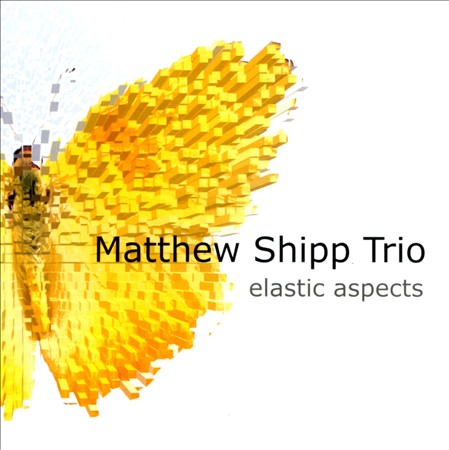
Matthew Shipp Trio, Elastic Aspects


The Matthew Shipp Trio today are a group like no other out there. Why? Because each of them have played through the bumps and jolts of the initial dues-paying period and ultimately triumphed as players of themselves. Surely there are influences, but as you listen to their new recording Elastic Aspects (Thirsty Ear 57202.2) you hear a group of artists who have become tempered in the fire of the scuffle to become their own instruments of expression. Matthew probes and hammers out his own vocabulary, new thing, repeating figures, harmonic-melodic vertical-horizontal aspects that come out of roots and branch upwards, rhythmic diversity, inside-the-piano extensions. Michael Bisio prods the bass with punctuated hammering, walks smartly like he is sure of the goal, plays arco with an individually distinctive tone and projective phrasing and fits into the group situation with his own version of what to do. Whit Dickey has his own version, too, in his case of the drum tradition and how it can be extended, whether it be in the playing time mode or with cascading freedom, and the grey areas in between.

There are 13 improvisational excursions on the album, each distinct. There are unaccompanied solos, duets and full trio segments. They fit together as pieces of what is NOW. In the end you get a very creative take on the new piano trio and how, in Shipp and Company's hands, it goes where it will and owes nothing to anybody. You can build, they seem to say, your own musical personality as individual and as a group in the full heat of the battle to survive and prevail. They do that here.

It is one of the important piano trios operating today. You cannot afford to miss them.

Thursday, December 22, 2011

Colin Stranahan, Glenn Zaleski, Rick Rosato, "Anticipation:" A Different Sort of Piano Trio


If you think that there is nothing new under the sun you may be wrong. Even if it is the same sun, the same "under," nothing really repeats itself in the same way. You can't step into the same stream twice, really. So with the venerable institution of the jazz piano trio. It's the piano, bass, drums configuration each time, but it's not always the same thing over and again. At least not with the trio of Colin Stranahan (drums), Glenn Zaleski (piano), and Rick Rosato (contrabass). At least not with their album Anticipation (Capri 74112-2).

Well then, how is that? These are well-schooled players who are out to capture your ears with some new trists, new twists and turns in the musical roads they traverse. There are a couple of standards (like "I Should Care") a jazz classic (the Davis-Evans "Boplicity") and a series of originals, one or more by each member of the group, that stand out. They stand out as memorable and they stand out because of the care the trio has taken with the arrangements. The latter is true of the entire program. Solos, nicely put together, are set off by nicely patterned arrangement sequences. Like the classic Ahmad Jamal trio, they are a kind of "orchestra in a box," with each instrumentalist having a unique role to play in the whole matrix for any given piece.

And what else? It swings with the happy abandon of some of Corea's classic trios from earlier times, when the players feel the spirit. And it creates other ways to make a statement around the solos as well.

Most importantly all these things work well, thanks to the excellent musicianship on display. Anticipation is no longer a matter of waiting. It's a matter of listening. Good listening to you!