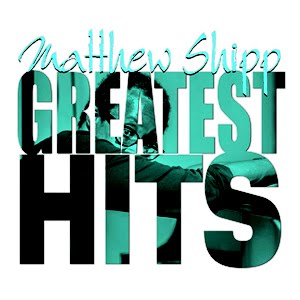
Late next month, Matthew Shipp will release a Greatest Hits (Thirsty Ear 57205.2) compilation covering some of his best work from 2000 to the present. Eleven albums are represented.
And listening to this compendium makes at least one thing clear (if not many things): Matthew Shipp has been a critical force in the new jazz not by holding steady to the same routines and patterns that have made for new jazz orthodoxy, but by opening up to the sounds around him, by not following trends, but by making trends follow him.
So we have not only Matthew Shipp the masterful, innovative pianist, but also Matthew Shipp the composer, the conceptual innovator.
Listen to "Cohesion," by his trio of the time of William Parker and Gerald Cleaver, plus Khan Jamal on vibes and Flam on synths/programming. The drums have that drums n' bass sound--very funky but also electronically worked over. Yet listening to the piece you do not feel that this is Shipp gone commercial, any more than Trane's quartet sounded that way doing "Chim Chim Cheree." It's Matthew Shipp incorporating new elements into his music--but it's always foremost his music and not anyone else's, by any standards.
So throughout the compilation you get solo piano, trios, and larger configurations, fascinating to hear broken into a more-or-less chronological sequence. It's Shipp the pianist at the top of his conceptual game, the artist free to create with the great players he has surrounded himself with, free to evolve his direction as he sees fit.
That, as the late Sam Rivers defined it, is what "free" is about. The artist is free to follow what path he or she chooses, where the music swings, takes it out into open air, or works within hip-hop/funk/rock rhythmic feels, or records with a large orchestra. Listening to the thirteen years of music making so nicely represented on this disk, you feel that Matthew Shipp has been true to himself, and what that is speaks truth to us all. This is important music, pianistically, group-wise, compositionally and conceptually.
So grab a copy next month if you don't know these sides!
 Monk, Jarrett, meet Jeff Holmes, a pianist who is related to you. He is carrying on with a quartet, on an album Of One's Own (Miles High 8621). He has grasped the essence of what you guys are about, and is taking it someplace of his own.