Showing posts with label contemporary jazz. Show all posts

Friday, June 26, 2015

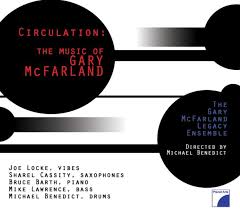
The Gary McFarland Legacy Ensemble, Circulation: The Music of Gary McFarland

To those that remember the music of Gary McFarland, the jazz composer and arranger who had some genuine recognition and a real presence on the serious jazz scene in the '60s especially, one must admit that he is not much remembered these days. All the more reason for the disk up for discussion today, Circulation: The Music of Gary McFarland (Planet Arts 301523). It features a quintet billed as the Gary McFarland Legacy Ensemble. Michael Benedict, the drummer and one of the arrangers for the program, heads the ensemble and gets co-credit with Kerry McFarland as Creative Director.

The band is a nice combination of Benedict, Joe Locke on vibes, Sharel Cassity on saxophones, Bruce Barth on piano, and Mike Lawrence on bass. Arrangements for the all-McFarland program are by Benedict, Barth and Kerry McFarland. They sound right.

McFarland died suddenly in 1971 at aged 38. But by then he had amassed a sizable legacy of compositions. The eleven numbers performed by the quintet here remind us of the substantial excellence of his music. His death was indeed a true loss.

Barth, Lawrence and Benedict have been playing together as a trio for a long while. Their closeness and empathy lay the foundations for some strong jazz. The addition of Locke and Cassity, both very accomplished musicians, complete the picture. All the front-liners are by now very much into their own thing and showcase the McFarland repertoire with a contemporary post-bop immediacy. The rhythm team puts a very solid foundation underneath it all.

The album is a real treat, a surprise to me because I had no special expectations at the first listening stage, yet it all jumped out and grabbed me straight off.

It is very first-rate music all the way. The McFarland compositions come to life again with a real presence, and the improvising & swinging manage to give the whole session living, breathing relevance and a contemporary timelessness.

This one is a winner!

Tuesday, November 11, 2014

Danny Fox Trio, Wide Eyed

Last March 27, 2012 I covered the Danny Fox Trio and their album The One Constant. They are back with a new one, Wide Eyed (Hot Cup 133) and it continues where the last left off. Once again Danny is at the piano, Chris Van Voorst Van Beest is on acoustic bass, and Max Goldman is at the drums.

Like The One Constant, Wide Eyed has a contemporary new jazz feel to it with rock influences and intricate compositional structures, a sort of Bad Plus in categorical terms via how much group structure is called for, but nonetheless with their own original compositional and improvising stance.

Danny composed the 11 pieces you hear; the entire trio had a hand in how they arranged the performances.

As with the last album there is space for open freedom and structure surrounding it. The music hearkens less to Paul Bley or Cecil Taylor new thing approaches and more, if you will, to "progressive" (even I dare say Brubeckian) and "new-music influenced" tendencies.

The compositions are well done and the trio makes a lively sound out of it all.

I recommend you hear these three. This album delivers its own sort of punch. Well done.

Wednesday, September 17, 2014

Fred Hersch Trio, Floating

In spite of serious illness coming in the way of his music Fred Hersch prevails and thrives in his new trio set, Floating (Palmetto 2171). He, bassist John Hebert and drummer Eric McPherson romp through standards and originals with true artistry.

What's so remarkable about Fred is that he can give us his own vision of the contemporary jazz piano trio (thanks also in no small part to his very game associates) that has roots in the mainstream yet ventures adventurously into inventive zones that do not hearken back as much as look forward. The Latinesque treatment of the opening tune "You & the Night & the Music" is a perfect example. Fred Latinizes the song in his very own way, generating excitement and charging the whole song with kinetic rhythmic energy. The title cut "Floating" follows, a beautiful ballad original that resists the almost inevitable backward look to Evans and others that most pianists in this zone would fall into. Yet Fred keeps it where HE wants it, plays himself.

The CD goes on from there and we get a full impression of the Fred Hersch Trio today. Not predictable, not content with status quo, yet very much within the flow of the great piano trios of the past. To do that and yet not sound derivative is no mean feat. Yet Fred and company do it and do it to a "t".

I recommend you hear this one. And hear it again. This is stunning music. Fred Hersch is a force today. The trio is, too.

Tuesday, August 26, 2014

Sly 5th Ave Presents Akuma

Sly 5th Ave (aka Sylvester Uzoma Onyejiaka II) makes his debut with Akuma (TRR-014). Still in his early 20s, Sly plays sax (tenor mostly) and writes/arranges a series of pieces for a full ensemble--a sextet augmented at times by additional winds, piano-organ, guitar, violin and voice. The music as Bob Belden in Sly's liners points out represents jazz out of the African diaspora. Sly presents an attractive Afro-jazz blend that does strongly resonate with some of the very promising sounds of jazz that were happening from the time of Coltrane's death through to the mid-'70s.

What that means is you get a mostly straight-eight percussive togetherness overlayed by well-composed horn and rhythm lines. It has affinities to late Lee Morgan, early-to-mid Elvin Jones, Pharoah Sanders, Herbie Hancock's Mwandishi, mid-period McCoy Tyner, and perhaps even a little Norman Connors.

But that doesn't mean it mimics these artists and their bands as much it draws strength from that tradition. Sly on tenor and Jay Jennings, trumpet, have strong solo presences, among others. The rhythm section of Ross Pederson, drums, Daniel Foose, acoustic bass, Keita Ogawa, percussion, and Cory Henry, keys, gets strong foundational grooves going and locks in.

The compositions have tensile strength and power. It's great to hear a band play in this zone, for there is still much potential to be had from this style of playing. Sly is already making a very good contribution with this music.

It's an album that impresses, an auspicious debut from a very promising tenor-composer-bandleader.

Hear Sly 5th Ave!

Monday, April 21, 2014

Mack Goldsbury's Quintet featuring Maciej Fortuna, Live at CoCo's

Working at Cadence as a review writer for many years, I learned that there are so many artists out there deserving greater recognition or working in what comes down to downright obscurity that I could no longer afford to say I knew the scene in and out. The arrogance of ignorance can never be a good thing. But it is especially detrimental in a music that unfolds itself primarily in real-time. So I guess you could say that being exposed to a wealth of rather unknown artists has humbled me.

So now as I continue on and today address a Bob Rusch Cadence Jazz release by a group I did not previously know, I remember that one can never know it all, that one learns by remaining open to the unknown.

Today we have Mack Goldsbury and his Quintet, Live at CoCo's (Cadence Jazz 1245). These are players I don't believe I've heard previous to this recording. I know them now! They are a hard-bop-and-after contemporary ensemble holding forth live in a small club in El Paso. The tunes are band originals, good blowing things, with the addition of "Autumn Leaves" and Monk's "Straight, No Chaser".

The presence of guitarist Shaun Mahoney in place of a pianist opens up the sound and gives the rhythm section a chance to burn up the swinging turf as they might in a pianoless trio, only of course there are three soloists on top in Mack Goldsbury on tenor and soprano, Maciej Fortuna on trumpet, and Mahoney on guitar when he isn't lightly comping. Erik Unsworth (upright bass) and Ricky Malichi (drums) have the field clear, then, and they take advantage with an infectious drive that makes it all foundational.

All three front-liner soloists have fire, guts and soul, and evoke the tradition while taking ownership of it for their time in the spotlight.

This is one fine set. It is where the hard bop rubber-meets-the-road and it has subtlety, too. It's a band I would gladly go hear, and yet I knew virtually nothing of them prior to the recording.

Needless to say it's a good one. Listen and learn! Meet new artists and you'll grow. Perfect example.

Wednesday, April 2, 2014

Matt Criscuolo, Blippity Blat

Altoman Matt Criscuolo comes at us with a very engaging new album, Blippity Blat (Jazzeria 2013). He is joined by a group of compatible heavies in vets Larry Willis on piano, John Clark of French horn fame, plus Billy Williams on drums and Gerald Cannon on acoustic bass.

This is contemporary-modern funk in the post-Horace-Silver sense. It has some of that old Blue Note resilience. Cooking and good blowing vehicles abound. It has soul but does not resort to the old cliches.

Matt has a slithering sort of chromaticism that sounds better than ever. Clark and Willis do what they do best, and the rhythm team has the power to get it all in drive.

The Criscuolo-Clark front line gets full use in the heads for a sound that reminds but gets a fresh face.

This is one very cool feather in Matt Criscuolo's cap!

Monday, February 3, 2014

John Tchicai, Tribal Ghost

The fact that the world lost saxophonist John Tchicai well over a year ago (October 2012) hadn't quite hit me until I heard the new posthumously released album Tribal Ghost (New Business LP65). It's not that I did not miss him as much as I hadn't internalized the loss.

Now that I've been living with this newly issued 2007 recording I feel it more keenly. He was to me an epitomization of the creative artists, the avant jazzman who could and did explore all kinds of territory, from the early pioneering new thing music of Shepp's NY Contemporary Five and the NY Art Quartet, to Ascension, to the post-thing Afro-exuberance of Pierre Dorge and New Jungle Orchestra, to his own varied later groups. He was not just an excellent alto-tenorist; he was a force in music.

Tribal Ghost reemphasizes that to me. It is also an excellent album. John plays tenor and a bit of bass clarinet (and chimes in with one composition), Garrison Fewell plays electric guitar and percussion (and contributes three of four compositions), Charlie Kohlhase is on alto, tenor and baritone, Cecil McBee is the bassist and Billy Hart is on drums. Now that is a group! The compositions center it all and give structure--and so this is not precisely a "free" date as it is an avant date.

The compositions and the mix of smart playing put this one in excellent territory. There is dramatic interplay, collectively, good individual performances, and a pacing and momentum that keep your ears open and attentive.

This is not the last word on John Tchicai or anybody else here. The fact that it isn't is in part why John was important. He encompassed so much. And so does everyone else on this date.

Definitely get this one if you can. It is a delight.

Wednesday, November 6, 2013

Michael Vlatkovich, Chris Lee, Kent Mclagen, Succulence of Abstraction

Here we have a live from Albuquerque date with a strong trio headed by trombonist Michael Vlatkovich, aptly titled Succulence of Abstraction (Thankyou MV 015). This is freely unfolding music in a pronounced jazz mode, swinging open form, with Vlatkovich joined by Kent Mclagen on acoustic bass and Chris Lee on drums.

It's one of those sets that gives you smart playing but hard swinging, too. It's filled with some great Vlatkovich trombone, not surprising given that he is one of a small handful of important forward-moving bone-ologists out there today. The rhythm team of Mclagen and Lee are fine indeed, both propulsors of excellence and players of substance in their own right. And the three-way effort is solidly knit together in the best traditions of the "pianoless trio".

There are head structures and lots of solo time in a post-new-thing zone. You could picture Archie Shepp added to this group easily. He isn't but that is OK because the three alone give you all the music you need.

A really good one, this.

Monday, August 12, 2013

Alex Snydman, Fortunate Action

Alex Snydman is that most unusual of musical beings, someone who switched from one principal instrument to another rather late in the game. Namely in 2003 while a college senior he made the switch from guitar to drums. And he's been playing them ever since. Judging from his album as leader, Fortunate Action (self-released), the move was most certainly the right one. He is a drummer of excellent finesse, capable of all shades of power and push, a timekeeper with great inventive capabilities which he brings to bear throughout the album.

These are mostly piano trios with the addition of Carl Clements on tenor and soprano for two cuts. For the rest Alex has opted to feature three pianists alternatingly, players he has had significant experience interacting with. They are Chris Pattishall, Doug Abrams and Miro Sprague. The bass slot is ably occupied by Alec Derian for all but two pieces, when Tyler Heydolph takes over.

This is intricate contemporary piano trio music that starts with a later Evans Trio sensitivity to interplay and builds upon that. None of the three pianists especially sound like Evans except in their harmonic sophistication; they are moving toward what they personally hear. They all sound good, as do the bass players. The main bulk of the compositions are by the various pianists and Snydman and they are worthy. Then there are a few classics like the Ellington-Strayhorn's "Star-Crossed Lovers" and Herbie Hancock's "Tell Me A Bedtime Story."

It's all so musical yet Snydman's drums are so important a component to the proceedings that you don't especially feel like you are listening to a "drummer's album," and I don't mean that in some pejorative sense (either way) but rather that this is an excellent set of piano trio/quartet sides.

And as you listen through a few times, everything hangs together so well you feel "fortunate" to be present for this "action," very much so. Recommended.

Monday, June 10, 2013

Noah Preminger, Haymaker

Noah Preminger comes at us with his third release, Haymaker (Palmetto 2163) and with it he shows us some more of his modern roots. We have a quartet here: Preminger on tenor, Ben Monder on electric guitar, Matt Pavolka on acoustic bass, and Colin Stranahan on the drums. There are mostly originals, by Preminger and one by Monder in an advanced contemporary vein. They are very good.

As I listened over time to this one I was once again impressed with Preminger's poise and sureness. He plays! And it also hit me that this band, whether they intended it or not, at least on this disk show heavily the influence of and pay a kind of tribute to the Paul Motian trio with Joe Lovano and Bill Frisell. There is a loosely swinging in-and-out quality here like that trio and the Preminger-Monder interactions show also a tonal-harmonic based spaciness of a sort that certainly the Motian trio carved out for themselves at times.

Well and so that isn't to say that these are carbon copies (a very dated metaphor alas), cc's of the original threesome. There is much very good music to hear and some strong original touches too. Preminger is extraordinarily lucid and has his own sense of what and when to play, though more and more I hear that Lovano-Bergonzi-Garzone zone in him, a Bostonian vibe if you will. He's young though and working his way to his very own rip of things. Monder is very good too and makes this group sound as it does in large measure. The rhythm team Pavolka and Stranahan have finesse and push to get this all moving.

You have to start somewhere with your music and at album three Noah has gotten off to an auspicious start. We will no doubt, most of us, be listening closely and eagerly to see where it all goes in the years to come. Meanwhile Haymaker gives us a very nice ride and bears close scrutiny well.

Wednesday, June 5, 2013

Chris McNulty, The Song That Sings You Here

Singers. Jazz singers. So many out there right now. So many releases. And in the thick of it all it sometimes hits me that to be a really great "jazz singer" is perhaps one of the hardest feats of all. You have the spirits of the titans behind you, never gone because so much a part of the tradition. Billie, Sarah, Ella, Carmen, Betty. Tough acts to follow. Some make it different, try to break the mould and go the way they hear it. Others straddle the tradition and give us mainstream styling that nonetheless is original.

Chris McNulty is in the latter mode. And she is very good. The Song That Sings You Here (Challenge 73341) will give you a good listen. It's Chris and a jazz combo. There are some McNulty originals, good ones. There are some standards not typically done, "How are Things in Glocca Morra," "Jitterbug Waltz," the beautifully bittersweet, regretful "Last Night When We Were Young."

She has subtlety, a nice instrument, phrasing chops. The arrangements have a limber quality yet do not seem "thrown together" with any sort of haste. And there are solid soloists to step in for a little instrumentality between choruses. Mike Ledonne gives us a nifty arrangement of "On the Street Where You Live" and Chris gives us a very nice set of vocalizings overtop.

So here's a good one! It's not rehashed by-the-numbers stuff. It stands out.

Monday, June 3, 2013

Keith Jarrett, Somewhere

Can it be possible that the Keith Jarrett Trio is becoming the most long-lived jazz group of all? They have been Jarrett-Peacock-DeJohnette for more than thirty years now. They are passing the MJQ or at least equaling them for longevity. It didn't seem like it was going to be that way when they made that first record of standards so long ago. But here we are and their new release Somewhere (ECM 2200) is with us. It's the three holding forth live at KKL Luzern Concert Hall in 2009, and they are in great form. Seemingly gone are the days when Keith's illness was a energy-technical-inspirational-limiting factor.

It's all back and it's still evolving. They do standards, of course. And they do them with the maximum flexibility they are known for and excel at (preposition endings nonwithstanding). There is the reappearance of the avant in Keith's playing, especially in the "Deep Space" unaccompanied prelude that begins the set, there is the mad bebop forays with brilliant lines cascading from Keith's fingers and imagination, there are the excellently subtle Peacock bass solos and ensemble work, and Mr. DeJohnette does wonders as he has for so long.

There's a two-chord vamp that extends "Somewhere" into the territory of the trio in their open mode. And there are simply beautiful re-harmonizations and re-expressions of some wonderful songs. All moving toward regions beyond, re-energized. So the travel continues.

This one is quite lovely--one of the best in recent years. Not that they've gone away at any point, but surely they are back with us in full force. Recommended!

Monday, April 29, 2013

Steve Slagle, Evensong

Steve Slagle has paid all the dues and more, and emerged as a saxophone mother! Listen to him on alto and soprano on his new Evensong (Panorama 004). It's there!

Three things are happening that make this album superior to the usual. One: Slagle and Dave Striker's interaction and solo prowess. Striker is some guitarist of course and shows it here. Two: the larger-than-life swing of a great rhythm section of Ed Howard on bass and McClenty Hunter at the drums. Hunter is a kicker! And Howard holds it together with style and heat. Third: a set of very game compositions by Slagle and a few also by Stryker, and then a beautiful version of Strayhorn's "Star-Crossed Lovers" with a moving Hodges tributorial nod.

It's the sort of CD you'll want to pull out to clear out the cobwebs and remind yourself why you were attracted to jazz in the first place. It has that kind of immediacy. Wow.

Wednesday, April 17, 2013

Nicole Mitchell's Ice Crystal, Aquarius

Nicole Mitchell has rapidly assumed a position of stature as one of the finest jazz flautists active today. Her string of varied albums in the past few years shows an artist who can lead ensembles of strength and originality and put together compositions that stand out, all the time hitting us with great flutework.

For her latest she takes a kind of look back with an ensemble and sound that has a relationship to the classic Eric Dolphy-Bobby Hutcherson Blue Note sides of years ago. The band is Ice Crystal and the album is Aquarius (Delmark 5004).

It's a fabulous gathering of Nicole, the increasingly central vibist Jason Adasiewicz, Joshua Abrams on bass and Frank Rosaly on drums.

Ten Mitchell originals push the band into some great zones, all swinging and smart. Nicole sounds ravishing and the Adasiewicz comping-soloing style sets her off perfectly. Abrams and Rosaly do all they might be expected to do--subtle swinging, hard and inventive. You can listen to Abrams doing some very hips things in there and Rosaly is a cat anybody would welcome on a gig.

This is another very solid, totally enjoyable building stone in the Nicole N. edifice. It will give her a wider audience, I suspect, and at the same time will not disappoint those of us who have been digging from the beginning.

Thursday, April 11, 2013

Manhattan Vibes, Blue November

If you've found yourself liking Gary Burton's vibes-centered version of contemporary jazz/jazz-rock over the years, you'll like that Blue November (Emarel 003) by Manhattan Vibes extends that tradition into the '10s. Christos Rafalides prevails on vibes and marimba and has the harmonic, chord-spelling sophistication of Burton with some of the two-mallet direct soulfulness of Milt "Bags" Jackson.

We have a quartet doing Christos originals, which are worthy blowing frameworks with finesse, plus a couple of standards. Joining Rafalides is pianist Sergio Salvatore, acoustic bassist Mike Pope and drummer Vince Cherico.

It's a welcome emergence of a real-deal vibesman and a very cohesive group doing some nice music. Fair enough?

Wednesday, March 13, 2013

Stefano Battaglia Trio, Songways

Those who like a piano trio that has both free-flowing post-Trane, post-Tyner/Alice Coltrane tremulous modal suspensions and the sort of poetic lyricism of Keith Jarrett, his precursors and those that have followed in his wake will find Stefano Battaglia's second album Songways (ECM B0017998-02) a good listen and an extension of those stylistic avenues.

As Stefano himself puts it, he was seeking in the new album a "harmonic balance between archaic modal pre-tonal chant and dances, pure tonal songs and hymns and abstract texture." The mix he achieves is a source of his originality as an artist. It is beyond the improvisational roots he shows by rooting itself in the roots of musical prototypes from romantic and pre-romantic, pre-formalist musics.

That is to say also that it is music that shows little trace of post- pre- and bop-inflected improvisation.

His trio mates support him freely and effectively in what is primarily a piano-driven sound. Salvatore Maiore has a full and harmonically pivotal role to play in the group and he does it well. Roberto Dani takes the sensuous sound producing property of his drum kit and non-pulsatingly activates accompanying gestures that flesh out the music appropriately.

It's balladic music that in some ways extends the quasi-impressionist aspects of Bill Evans and Paul Bley and their work in this vein. But in so working in this area Battaglia comes to a personal lyrical center in himself that grows the music and shows much artistry.

A new balladry, then.

Thursday, March 7, 2013

Charles Lloyd, Jason Moran, Hagar's Song

Charles Lloyd sounds as good as ever, maybe even better. Jason Moran always seems to sound good. He is a pianist's pianist. Jason has worked with Lloyd's band in recent years but to my knowledge never recorded with him as a twosome. Put them both together for a series of duets and you have Hagar's Song (ECM B0018001-02), a good thing indeed.

The tenor-piano team tackle of wide variety of material, from Earl Hines's "Rosetta" to Brian Wilson's "God Only Knows," and from Duke's "Mood Indigo" to a tribute to Levon Helm, with a version of Dylan's "I Shall Be Released."

Lloyd's "Hagar Suite" forms the core of this set. It comes to terms with the life of his great-great grandmother, who was sold into slavery at the age of ten. It is a moving tribute.

This is music with a timelessness. It is neither new nor old, but both. It is a Lloyd-Moran representation of a wide musical tradition, of historic tragedy, of being alive today within tradition and aware of history. Hagar's Song is highly personal and often sublime.

Friday, March 1, 2013

Ibrahim Maalouf, Wind

Imitation in jazz is not something recent. It goes back. And it's true of all musical pathways. Some imitation tries to disguise itself as innovation, and that's where things get sticky. Other imitations openly acknowledge the debt and manage to say something very new with something less new as a springboard.

Music moves forward when this happens. Take Ibrahim Maalouf, jazz composer, trumpet wielder, arranger. He makes no bones about what he is doing on the album Wind (Harmonia Mundi Distribution). It's music written for the silent film "The Prey of the Wind." Maalouf set out explicitly to create the music as a homage to, and extension of Miles Davis's late '50s soundtrack to Louis Malle's "Elevator to the Gallows." At the same time Ibrahim wanted to utilize his quarter-tone trumpet to get further extensions to the sound he heard.

He assembled a quartet that included Mark Turner on tenor, a group that could not only get with that spacious, moody late-'50s Miles thing--and especially with that soundtrack, VERY spacious and moody--but at the same time feel comfortable with the Mid-Eastern, North-African elements of Ibrahim's music.

Wind is the album that came out of the project. It is dedicated to Miles, understandably. By starting out with a homage, Maalouf has created something that doesn't just extend or imitate the Miles of that point in time, it becomes strikingly its own music. Maalouf's trumpet playing is something to hear, and the compositions-arrangements feel like a complete contemporary statement, the real thing. And a very good thing at that. It's striking!

Friday, February 15, 2013

Accidental Tourists, The L.A. Sessions

The lyrical side of contemporary jazz has been flourishing for some time. Keith Jarrett has something to do with that, as we know. Bill Evans, too. Chick Corea can't exactly be ignored, either. Nowadays there are scores of very good pianists out there who don't especially sound like any of the above, yet widen the path to the singing melodic-harmonic pianism that can appeal to so many yet remain musically sophisticated.

Markus Burger is one such pianist, a very good one. His group Accidental Tourists is a trio with ex-Evans vet Joe LaBarbera on bass and Bob Magnusson on drums. They've got a new, nice one out, Accidental Tourists (Challenge 73332).

The disk contains mostly Burger compositions, and they are ringing testaments to the Burger way of proceeding. The trio has that interactive thing going that no modern-day trio should be without, which means that the bass and drums have a large role to play.

At Cadence for a while Bob Rusch dubbed me the go-to guy for piano trio reviews, partly because I found it a natural thing given my interests, and I hope partly because I was steeped in the piano history-tradition and could pick up on what was going on. I cover a lot more ground in my blogs than I tended to do at Cadence, but an excellent trio such as this one warms my heart as ever. These three stack up!

This is music to live inside of and relish. These folks are good. So don't miss it if you look to supplement what you listen to with some new names.

Monday, February 4, 2013

Empty Cage Quartet, Limited Edition LP on Prefecture

The Empty Cage Quartet has been filling the West Coast and elsewhere with good sounds for ten years now. They have a relatively new recording out, a limited edition, self-titled LP (Prefecture 06).

The LP sometimes has an advantage that we used to see purely as a disadvantage, the shorter playing time. Some music gets into our heads easier and more completely in shorter doses. I wouldn't go so far as to say we should return to the 78 and the 2 x 3 minutes format, but any length of music surrounded by the silence of the after-end has a distinct discipline by virtue of time. So the LP clocks in around 40 minutes and must say whatever it does within that time frame.

The Empty Cage Quartet makes new music and one must get into it on its own terms. It has some of the two-horn influences of Miles' Filles de Kilimanjaro and Ornette's The Shape of Jazz to Come, but only in a hereditary sense. Empty Cage music is its own music.

Jason Mears, alto sax and clarinet, Kris Tiner, trumpet, Ivan Johnson, bass, and Paul Kikuchi, drums and percussion define the music personally, improvisationally and compositionally.

There are one and two-horn parts, both written and improvised, that stand out. Paul Kikuchi, like Tony on Filles, sometimes has almost a concerto-like role to play in the music, providing outstandingly inventive figures. Ivan Johnson imaginatively and firmly anchors it all.

Rock-steady, free or swinging, it hangs together with contrasting linear and circular qualities that work together to make something important. But hold on, it goes by in a hurry, each side keeping you riveted with nothing at all extra, just the essence.

ECQ is essential, essentialized and irresistible for those with the ears to hear it. Grab one of these while you can. You'll be glad you did, I think.