Showing posts with label avant garde classical. Show all posts

Friday, March 4, 2011

Mark Applebaum and The Metaphysics of Notation


Mark Applebaum has entered a new world of his own making with his The Metaphysics of Notation project. It is documented on a recent DVD of the same name (Innova 787). Only a DVD could begin to cover the scope of the project with justice, because the work combines visual art, installation, performance art and musical execution as a totality.

The central raison d'etre for the work was the creation of a 70-foot linear pictographic "score" (w/several hanging mobiles) that Applebaum created on paper by hand, black symbols proceeding from left to right as in a conventional music manuscript. The "score" is without the usual staves, and the notations Applebaum has made are in the form of a varied and elaborate series of pictographic images meant to flow from one to another as would standard notation. The symbols and graphic images sometimes approximate musical notation in the sense that they utilize note symbols on occasion, but graphically enhanced and without the staves as context. For the rest the score is filled with images that suggest a visual representation of an open-ended musical sound-world. Some of the images are abstract, some representational, but all sequence together in ways that suggest a series of musical events. The score is as much a work of visual art as it is a quasi-prescriptive set of abstract visual analogs to guide and direct individual content decisions made by musicians in any given performance.

The score was installed as a number of large horizontal panels (plus mobiles), on view for a year at the Cantor Arts Center Museum of Stanford University.

The DVD addressing Applebaum's work is in three parts. The first is a documentary about the project, with commentary from the composer and a number of composer-musician-musicologists either involved in the project's realization or familiar with the work's parameters. The documentary also introduces you to the score itself and its installation context.

The second part consists of recorded one-minute excerpts from the 45 performances held at the museum on a weekly basis, accompanied by stills of each particular performance. The musicians involved vary from a single soloist to a moderate sized ensemble. Each performance group was left entirely free to make whatever musical sounds they deemed appropriate in realizing the musical implications of the score.

The third part of the DVD consists of two slowly scrolling panoramas of the score itself, one lasting eight minutes, the other sixteen.

In the end I was left with an appreciation of the imaginative scope of Applebaum's project. The documentary raises questions about the borders of legitimacy or even intelligibility when it comes to such work. Is it music? Art? Installation? Improvisation? Performance art? It is all of that. The difficulty perhaps in this is that, since there is no right or wrong way to realize the musical potential contained in the score, since Maestro Applebaum does not provide anything in the way of specific musical directives or suggestions, anything goes in a given performance. There is no "proper" or "improper" performance, no "good" or "bad" version. That is problematic only in the sense that the status of the work remains completely open and ultimately neutral. It does not exist in some tangible sense aurally. This will bother some people. Essentially though, at least the way the project is set up, it is the interaction of visual stimulus of score as visual art, the natural reverberant ambiance of the museum setting, and the free improvisations of the respective musicians that work in tandem to create a kind of totalized art-music gestalt. The 45-minute series of excerpts of the various musicians at work affirm how different any given performance can be from another. It's fascinating to hear and see.

I find the DVD quite illuminating, Applebaum's project thought-provokingly beautiful visually and conceptually, and the music absorbing. I recommend this one very much. By the way you probably don't want to miss the one-minute excerpt of the Stanford Mobile Phone Orchestra tackling the music!

Thursday, February 10, 2011

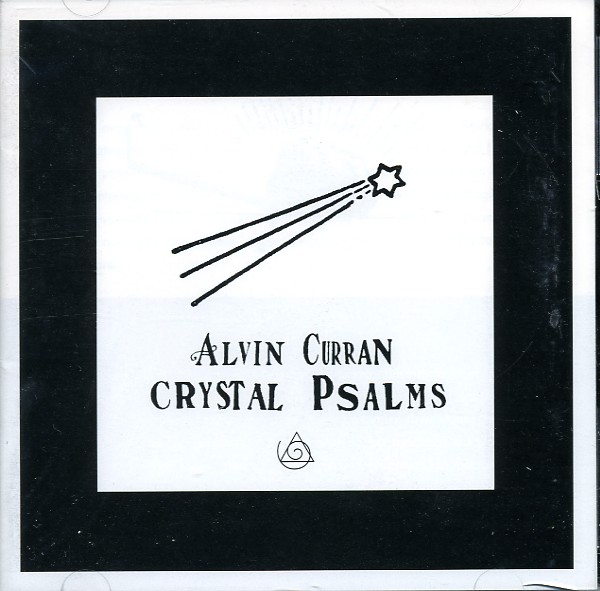
Alvin Curran's Moving "Crystal Psalms" For Large Ensemble(s)


In the context of another review on these pages I believe I wrote that I considered Alvin Curran a key figure in the avant garde music scene of the past 50 years. I continue to believe that and I continue to believe posterity will bear me out on that point.

I wont re-rehearse the argument here. I will however talk about one of his gems, the 1988 work for multiple choruses, instrumentalists and pre-recorded tape, Crystal Psalms, which is available if you look for it on a New Albion CD release (NA067CD).

The piece was first performed to commemorate the 50th anniversary of Kristallnacht, a horrifying night in 1938 when the Nazis began the pogram-holicaustic violence against Jews in (deadly) earnest.

Curran's work is disturbing, of course. How could it not be? But it is much more than that. The work was designed to be broadcast live in most of the major European cities. Six radio stations scattered across Europe handled the simultaneous six-way performance of the piece, each with a moderate-sized chorus, a string or wind quartet and an accordionist. None of the groups could hear what the others were doing, but the realization was coordinated (via a time track) so that all six musical groups played their parts in synch. Complementing these musical ensembles were taped sounds of glass shattering, Cantors, a shofar horn, praying at the wailing wall, percussion barrages and other evocative sounds. Radio audiences heard a mix of all six audio feeds which represented the score in its totality.

It is a long, sprawlingly gigantic, enormously moving work. It should not be missed.

Tuesday, February 1, 2011

Jexper Holmen's Oort Cloud: Sustained Sound-Poetry at a High Level


What is an Oort Cloud? It is a massive cloud of comets that surrounds our part of the universe, a great distance away in human terms, but local presumably on the infinite universe level.

Danish composer Jexper Holmen has composed an hour-long work based on the contemplation of that formation. It is entitled Oort Cloud and has just been recorded and released as a Dacapo Records CD (8-226562).

When I worked at Scientific American books, the then-president referred to comets in a launch meeting as "those snoozy things." True. Get one of them in isolation, they are rather just "there." Put them in an Oort Cloud surrounding our friendly neighborhood universe-space and they become rather mysterious and at this point, ineffable.

The same might be said for Holmen's composition. One minute of it will not bring you to your feet with shouts of "Bravo!" An hour of this music very well might. That's because it's the cumulative effect of the musical cloud, hovering over our aural world, that becomes increasingly mystical, as it were, in its ever-presence.

The nuts and bolts of it are as follows: there are two accordionists and what sounds like an alto or soprano sax, situated in a resonant performance space. The accordions play continuous key-less tone clusters that shift gradually note-wise and vary in dynamic levels. The saxophonist gives out periodically with long multiphonic blasts and quieter soundings of same, as well as overtone-rich sustain notes. The key operative here is "sustain." The music is a continuous series of long tones that form collectively a kind of musical equivalent to the Oort Cloud.

It's ambient. It has patches that are fairly dissonant. The resonance of the performance chamber and the continually shifting blocks of unusual sound clusters make for an aural experience that has a kind of expansive effect on the perceiving hearer. It can become a kind of meditation on the mysteries of the universe and that cloud of comets that ring our world. That was what I began feeling as I listened over time.

There is nothing quite like this piece out there.You may love it, you may hate it, but you cannot ignore it. That says something. In that way, as in other ways as well, this music is a ringing success. Don't go near it, though, if you expect some kind of entertainment. It is rather more serious than that. It's almost a form of knowledge. For all that, it is unparalleled among works being produced today.

Monday, December 13, 2010

Mark Applebaum's "Sock Monkey" Goes Everywhere in Interesting Ways


From the very first listen to Mark Applebaum's CD Sock Monkey (Innova 706) it is clear that there is a stylistic restlessness somewhere lurking in the depths of the composer's being, and he makes very creative and credible use of it to cover a great deal of ground. There are some intriguing chamber ensemble and orchestral pieces in the modern classical mode, pieces for solo instruments, electro-acoustic ensembles, a solo for 18 prepared pianos (apparently one at a time in succession) based on a Mozart theme, there's a piece for several soloists plus live electronics, and on from there.

However it's not only that he isn't afraid to construct music for very varied resources, it's his success at doing so. There is an Applebaum sensibility, an original voice in operation throughout. So it's beyond eclectic and more in the realm of sonically extended original music. And it is indeed a hoot.

Applebaum manages humor, pathos, revelry, expressionism and parody all in various combinations in these works. Listening is a thorough pleasure. His is an avant garde that wears its approach lightly, yet quite seriously. It is a knockout disk.

Friday, November 5, 2010

Morten S. Danielsen's "Donalds 09:" Punk Opera?


Let's face it. We approach any new work of music with a set of predispositions that comes out of our experiences with music we have heard and familiarized ourselves with throughout our lives. When a new work comes along that does not fit in with what we know, difficulties can arise. That explains in part the hostile reactions that historically occurred at the premiers of works that defied the expectations of listeners in that local-historical time and place. So The Rites of Spring, the Eroica, nearly all of Mahler's symphonies, as examples, met with incomprehension and hostility in their first performances. It was only as audiences began to become familiar with the music that they came to appreciate what seemed so jarring at first.

I had that reaction as I first listened to Morten S. Danielsen's opera Donalds 09 (DaCapo 8.226563).

The sequence of reactions went something like the following.

First listen: Oh, yeah? Who told you you could make music like that? Second: Hmm...there's something to all this craziness. Third: I LIKE this but I don't understand what it is. Fourth and Fifth: I think I understand what the composer is doing and see the unique musical-dramatic logic involved, as much as it is clearly articulated. I have come to be drawn, odd as some of it is, to the recurring motifs and emotional-structural arch of the piece taken as a whole.

There are plenty of "crazily avant" CDs out there but Danielsen has a particular flair to his avantness that is ultimately appealing. But we need to start over at the beginning. Danish composer Morten S. Danielsen did not live to complete this opera, presumably his last work. It is a work with a certain sort of punk cockiness to it, which seems to be one of his trademark stances. It revels in the flippantly outrageous/funny-deadly serious edge of expression. This is one of the factors that makes it especially unusual and interesting, at least to me. Apparently Danielsen was a sort of Kurt Cobain-ish tortured and self-destructive soul. His music seems to reflect that.

The plot/libretto to Donalds 09 is disjointed and somewhat opaque. There are three Donald's, one a woman. The opera is a kind of bildungsroman of them trying to articulate who they are or are not. And ultimately the three Donalds seem to be three personalities contained in one person. Rather than a "coming of age" journey, though, the characters seem more to be in the process of "coming apart." Ultimately it is the sound worlds which bring these struggles alive that make the work so intriguing to me.

The unusual combinations of distinct musical sound colors and their masterly repetition-development-appearance-disappearance truly set Donald 09 apart from other avant works of its type. Some of the salient sound events that weave in and out of the work: an ensemble of what sounds like bell ringers, concrete and pure electronics, an electric punk-rock band, two distinctive electronically altered vocals, conventional operatic vocals, small-group chamber or solo piano accompaniment, baritone sax obligatto passages, choral ensemble, recitation, a child's squeaking rubber duck (?), vocal duets with altered and unaltered voices, and the climactic sequence that I wont even attempt to describe, except to say that it seems to prefigure the composer's own death and it haunts the aural memory long after it is played.

I don't know what the future holds for Donalds 09 in terms of its reception. I do know that it is a profoundly moving, even disturbing work that presents a sound world and libretto so idiosyncratic unprecedented yet so compelling that it surely should not be ignored by anyone who wants to embrace what is new and interesting today. It may be a milestone. Or a madman's self-indulgent ravings. Or both. We've seen that before. Don't miss this one if you want to overturn your preconceptions of what opera can and should be.

Monday, September 20, 2010

Paul Hartsaw's SocioCybernetic Music Machine, Oakland 2007


The world of "free jazz" and improvisation (or improv) and the world of avant garde classical have been converging for some time now. In opposition to the "Third Stream" concepts put forward in the late '50s by Gunther Schuller and others, the musical rapprochement does not necessarily combine the musical syntax of jazz and classical vocabularies. Rather there has developed a language of sounds and intervalic relations that both groups hold more or less in common.

By utilizing various schemas to encourage both improvisational discourse and sonic innovation, artists from both sides are creating musical works that involve all participants in the decision of what to play and when. Sometimes there is full notation and individual decisions are made on the level of timing and ordering of the music at hand. On the other end is the intuitive group improvisation, where a kind of total choice is available on the part of artists, subject, of course, ultimately to the approval or disapproval of fellow artists and audiences.

Somewhere in between is the music produced by Paul Hartsaw's Octet in a project he calls the Socio-Cybernetic Music Machine (SCMM), recorded in performance in Oakland in 2007 (Metastable Sound 012). As I understand it, Mr. Hartsaw created a performance schema where individual musicians were instructed at various times to remain silent, to play, or to "take initiative," to play in the manner of a soloist. Musicians were given written motives to sound as well as given times where they could freely improvise.

The end result is a performance lasting 51-odd-minutes, controlled in part by Paul Hartsaw's role as "signaller," a kind of combination traffic cop and conductor.

The octet consisted of seven musicians and one vocalist, and the performance that ensues I trust is only one of infinite numbers of possibilities.

And so does the music have and retain interest? Yes. It has that free-abstract improvisational sound one might expect, somewhere between Stockhausen's improvisational pieces and the AACM in their more avant mode.

It is music that takes a number of listens to accustom oneself to, as is usually the case with any sort of complicated and advanced work. There are moments of comparative repose and moments of density and energetic activity. What Hartsaw's schema does is ensure that there is sonic variety and contrast in every performance. Like more conventional jazz, the music depends heavily on the imagination and ability of the artists. Like more conventionally conceived avant modern concert music there is a more or less ordered presentation of musical events that proceed in linear fashion from point A to point B.

The CD is recommended for those who like to explore ensemble abstractions. Paul Hartsaw's structural and personal direction of the sounds ensures that there is interest and variety. Recommended listening.

Tuesday, July 13, 2010

Harley Gaber Today: "Mount Fuji" Soundscape


Harley Gaber in my mind will always have the distinction of composing and recording one of the most extreme instrumental avant garde classical pieces I've ever heard. The Winds Rise in the North is a work for string group, originally released as a two-record set in the early-mid '70s. What made it rather extreme was his treatment of dissonance. The original 12-tone composers, the serialists and post-serialists dealt with dissonance generally in a pointilistic way. The bleep and bloop sort of music may have had no harmonically tonal basis or a very expanded one, but the music generally gave you dissonances as if they were tiny points of light on a screen or literally (with some of John Cage's piano music) as a representation of stars in the firmament. For audiences unaccustomed to hearing unresolved dissonance as part of their musical experience, the pointillistic presentation gave the listener some space between tones and also consonant intervals to relieve the tension, for the most part.

The Winds Rise in the North pretty much did none of that. Gaber approached the use of tone in blocks. The string group generally started softly with ever crescendoing complexes of often boldly dissonant sound. The music seems to have represented the build-up of wind currents in some rather extreme weather event, or alternately, some sort of cosmic apocalypse. When those blocks reached their various climaxes, the sheer intensity of continuous dissonant sound (albeit of much interest as sound color) was exhilarating for some, excruciating for others. I still consider it a masterpiece of the era, but perhaps one that many would find hard to sit through.

His latest recording, I Saw My Mother Ascending Mount Fuji (Innova 231) is quite another story.This hour long work, composed between 1968-2009, involves a combination of a piece for multi-track violin and one for processed flute, inserted into an electronics matrix devised by the composer.

Like the Winds Rise in the North, Mount Fuji sprawls throughout its hour-plus duration using long-toned, gradually evolving, wind-like sound-color events as its way of proceeding. Unlike the Winds piece, the music here is much less dense, much less dissonant, and makes for an entirely pleasing listening experience. It's a soundscape of some delicacy, with sustained long-form utterances of a kind of frozen beauty. As much as I appreciate his earlier masterpiece, Mt. Fuji is far more listener friendly. It is a mysterious mountainous essay that speaks as much through omission as commission. And it sounds rather stupendous coming out of the speakers.