Showing posts with label chicago jazz. Show all posts

Thursday, October 11, 2012

Fred Londberg-Holm's Fast Citizens, Gather

The latest CD from Fred Lonberg-Holm's Fast Citizens is a corker. It's called Gather (Delmark 2017). This is a coterie of Chicago jazzmen who can play, led by Fred who can also write. All but two of the numbers were written and arranged by Londberg-Holm and they work very well with the players at hand. The front line is a potent mix of Aram Shelton, alto sax and clarinet, Keefe Jackson at the tenor and bass clarinet, Josh Berman, cornet, and Fred, cello and tenor guitar. When backed up by the one-two thrust of Anton Hatwich and Frank Rosaly (bass and drums, respectively) this is one heady mix. There are group improvisations of an exhilarating kind, very good individual solo spots and arrangements/comps showing lots of imaginative creativity.

The group has character--every player is a fully developed improviser with a sound, and Fred uses that and their abilities to build impressive performances that are out and structured at the same time.

There is point in the final cut, "Roses" where it sounds as if everyone is on trumpet and that is pretty funny!! But otherwise this is seriously good avant jazz from strong players (and writers). It gets down to business carving out seven niches of exciting avant jazz, showing you why Chicago is still a major center for the music. Get this one by all means.

Tuesday, November 1, 2011

Darren Johnston's Gone to Chicago, "The Big Lift"


Yesterday, Darren Johnston with the Nice Guy Trio.... Today, Darren Johnston with Chicago guys. Darren Johnston's The Big Lift (PFR Porto Franco 031) came out late this past summer (2011) and it's worth tracking down. A great lineup doing some very good music....It's Darren on trumpet, Jeb Bishop on trombone, Jason Adasiewicz, vibes, Nate McBride, bass, and Frank Rosaly, drums. In other words, a kind of all-star Chicago lineup.

The group goes through its paces with Ornette's "Love Call", Duke's "Black and Tan Fantasy" and six Johnston originals, all of which make for fine semi-expanded springboards for these masterful improvisers. Needless to say Darren holds his own and each is an original voice. Jeb and Darren make for a wildly creative front line and Jason is his usual stimulating self with extended harmonic comps as needed and well chosen lines. The rhythm team socks the monkey in ways that make them a hell of a good choice for a freely propulsive set such as this.

Most definitely this is one you should not miss. It's a real feather in Mr. Johnston's cap and the Chicago crew is right there on it!

Friday, August 19, 2011

Aram Shelton and Arrive Present an Interesting Program of Quartet Music on "There Was"


For those of you like me who are digging some of the interesting ensembles loosely based in Chicago and taking a post-Dolphy trip through composi- tional-improvisational in & out territory, the new CD by Arrive should appeal. Altoist Aram Shelton has a wry sort of pluck to his solo work. He now resides in California where he is a part of the group Cylinder (see review on these pages), but he reunited with some of the Chicago luminaries for There Was (Clean Feed 217). Vibraphonist Jason Adasiewicz has real presence on the contemporary scene. As a sideman with a group such as this there is a Bobby Hutcherson spatial looseness to his comping that does a great deal to open the music up and he soloes with good taste and intelligence. (His solo recordings, also reviewed on these pages, put him in a more chimingly extroverted zone, but that is another story). Bassist Jason Roebke and drummer Tim Daisy are mainstays. They combine the ability to get inside the structure of a composition with a playful freedom that suits the context well.

The compositions are rich and complex, yet bring a modern jazz rootedness that pulls it together in the best tradition of the outside Blue Notes of the classic period.

This is an excellent ensemble outing. Highly recommended.

Tuesday, August 16, 2011

Ken Vandermark Solo "Furniture Music"


If you think it's easy to make a solo woodwind improvisation album and keep it interesting, then you have an optimistic outlook on just about everything, I would think. It's you, your instrument and a microphone or two and that's it.

Ken Vandermark made such an album a few years ago. He perhaps ironically titled it Furniture Music (Okka Disk 12046). For those that don't know, "Furniture Music" was the name of a set of pieces Eric Satie composed for social situations where the music was to be a background to the convivial gathering of folks, their chatter, the tinkling of ice in cocktail glasses and the like. He was ironically adament that the music be ignored. The music was purposely banal and repetitious, but since it was Satie doing it it turned out that the music was really quite fascinating and a prophetic forerunner to what was later known as minimalism.

For Ken to call his solo reed recording by that title, he was applying a bit of modest irony to his own music. Like Satie's piece, this is not really background music at all, and in a way it was a comment on how difficult it could be to improvise on a single-line solo instrument for any length of time while retaining audience interest.

Vandermark's Furniture Music succeeds because he is a very creative cat. The bulk of the recording was made in the studio, but the final numbers are from a live date. Ken's strategy was to keep each segment relatively short, to vary the instrumentation, and to limit the tone production and sound qualities of each improvisation to certain parameters. So you get explosive pops as a sound event on the baritone sax, legato clarinet, boppish bari phrases, squealing shrieks on the clarinet, subtones on the bass clarinet, and so on.

Needless to say perhaps, but this is not a disk where one expects Ken to break out into a version of "Body and Soul." And he doesn't. It IS a varied and adventurous trip through the colors of sound and tone poetry Vandermark creates in the course of the 65-minute program.

This may not be an album that changes the universe and its ordering. It may not even change your idea of music if you already have sampled "free" improv. But with a Zen sort of concentration on the part of the listener this is music that is far from boring.

Monday, August 15, 2011

Nicole Mitchell's "Awakening": Flautist On Top


In case we need proof, Nicole Mitchell's Awakening (Delmark 599) shows us that Ms. Mitchell has become one of the premier flute players today. It's a swinging quartet date with well-chosen players, some of Chicago's very best. And it's about as close to straight-ahead as you are likely to hear from Nicole. Now don't make the mistake of thinking that straight-ahead is necessarily synonymous with playing it safe, with endless repetitions of licks and cliches from earlier musical styles. That may be the unfortunate case for some players, but not these folks. NO! Ms. Mitchell does NOT play it safe. And her playing is Nicole right now, not somebody else rehashed.

The compositional elements remain a key part of Ms. Mitchell's way but this time they are primarily springboards to extended band improvisations. Along the way Nicole shows big bright tone, great agility, strong creative control over tone color and an imaginative choice of lines that put her straight-up on top. Jeff Parker on guitar never sounded better. If he sometimes brings to mind Ted Dunbar on this date, it is only in the sense of the restless searching, probing quality of his lines. Harrison Bankhead, as anyone who has listened knows, is one big powerful mother of a bass player and he puts it all out there for us to hear. Drummer Avreeayl Ra is a name less familiar to me. But he gets in the pocket of whatever they are doing: swing, rock-funk, freetime, and STAYS there.

This isn't tame music. It is not music that holds back. It is not music that treads lightly for fear of bending a branch or snapping a twig. It goes where it will with no fear, with great spirit, heartful soul, and a wildly exciting ride to get us all there. This is one f=terrific group and Nicole is life affirming and breathtaking at the same time. Dig this one deeply and you'll get to another place.

Tuesday, May 10, 2011

Ernest Dawkins' New Horizons Ensemble Comes Through with "The Prairie Prophet"

Chicago's Ernest Dawkins has been making some very goodly music for some time now (11 CDs so far). His New Horizons Ensemble has been a big part of the scene since 1978! On The Prairie Prophet (Delmark 598) Dawkins runs the mid-sized, seven-artist cast through in-jazz to out-jazz compositions that have plenty of latitude for the considerable improvising abilities of the players while emblazoning a distinctive stamp on the sound and thrust of the music.

This is a well-paced set, dedicated to the great tenor institution Fred Anderson, who passed away last year after a long and luminous career as improviser, mentor and owner of the famed Velvet Lounge, where Dawkins had the opportunity to work frequently, honing the long-running ensemble and their group sound.

And it's some group. There's Dawkins himself on alto and tenor, a force of distinction; trumpeters Marquis Hill and Shaun Johnson, good soloists and a burnished, bright "section" sound color; Jeff Parker on guitar, a man fully versed in the roots of his instrument and fully able to take it into orbital outness when called for; trombonist Steve Berry, one of Chicago's very best on that instrument; and the creative, brilliantly spontaneous yet team-oriented rhythm section of Junius Paul (bass) and Isaiah Spencer (drums).

It is not a contradiction to say that the right kind of band, one with a certain amount of free playing by first-rate new improvisers, can become ever more tighter in their freedom as they continue to work together. That is most certainly the case with the New Horizons Ensemble. There is no dead space on The Prairie Prophet. Solo spots are incisive, ensemble grooves are focused and hard-hitting, the free-er moments develop and move linearly from point A to point B in creative ways, and the compositional elements totally integrate into the performance, allowing breadth, latitude, and performative elements their due.

This CD is in many ways a bit of a masterpiece. It shows that Dawkins and Horizons are making some of the finest jazz coming out of Chicago today. And that in a city still central to the music!

Monday, December 6, 2010

Vibist Jason Adasiewicz Shines in "Sun Rooms" CD


Chicago vibist Jason Adasiewicz has been making important contributions to some landmark record dates in the past several years. His work with the Lucky ‘7s comes to mind, among others.

Now he makes his debut as a leader on Sun Rooms (Delmark 593). It’s a nicely manned trio with Jason plus Nate McBride on bass and Mike Reed on the drums, both of the latter important participants in the latest wave of great Chicagoland modern jazzmaking.

Adasiewicz in larger ensembles (at least on records) tends to excel at the staccato jab phrases that come out of the lineage of Bobby Hutcherson, though Jason has his own musical sensibility. In a smaller group such as this one, unencumbered by the need to accommodate one or more solo voices, he stretches out his phrasing and allows the vibes to ring a little bit more than he might do in a larger ensemble. In that sense the great Walt Dickerson comes to mind, if only as a referent. The music sometimes tends toward the contemplative side, with some wonderfully laid back neo-balladic playing. But there are also numbers that have forward-moving momentum and plenty of energy in reserve.

There are some excellent originals here plus an affectionate, legato look at Ellington’s lyrical "Warm Valley". Everyone is on his “A” Game, not the least Mr. Adasiewicz. Sun Rooms is a superb outing and probably the vibes album of the year. It is chamber jazz at its finest.

Tuesday, July 20, 2010

Keefe Jackson and Quartet Notch Off A Winner


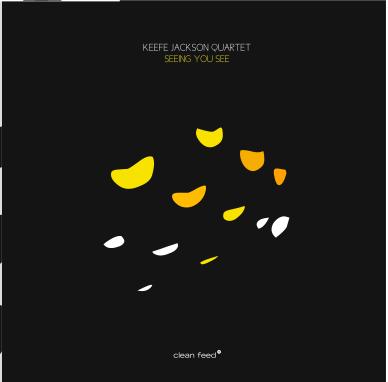
Chicago. I've written about some of the very lively music coming out of there on numerous occasions. Today, another CD by some of the brightest in the firmament. Keefe Jackson, with his tenor, his bass clarinet and his jazz compositions, leads a quartet on the new Seeing You See (Clean Feed 176). It's a superb combination of musical vehicles and lustrous blowing.

Keefe has his own sound and approach. He is not given to the continuous unleashing of extra-timbral resonances (nothing wrong with that, though), but concentrates more on creating interesting lines. He is in terrific form on this album. Then there's Jeb Bishop, a trombonist that perfectly aligns stylistically with Jackson. He too is after the expressively outgoing linear improvisation. And he happens to be one of the most formidable trombone talents to come along in quite some time. The rhythm section finds the virtually ideal embodiment in Jason Roebke on bass and Noritaka Tanaka on drums. They can swing strongly or take a more diffuse freetime approach, or something in between the two (which may be hardest to pull off) depending on the character of the piece at hand. And they do it with seeming ease, which belies the hard work and dedicated realization of talent that it takes to get to their level.

I find just about everything that this loose confederation of Chicago cats put across to be important music. This one takes the legacy of Ornette's classic pianoless quartets and builds a new, sparklingly clean-edged edifice on top of it. Highly recommended.

Tuesday, May 18, 2010

Paul Hartsaw Tentet in Chicago, 2004


As anyone who reads my blogs knows, Chicago is a territory of great interest to me musically. The same with Boston, New York, New Orleans and in the widest sense, Europe.

Why? Not to take away from other scenes, many of which produce good things, but these aforementioned locales produce new and exciting music on a consistent basis. I speak of the jazz/improv front.

So today if you don't mind I want to backtrack to a slightly earlier release by the Paul Hartsaw Tentet, Chicago 2004 (Metastablesound). This is a formidable lineup captured live. Paul Hartsaw plays the tenor and soprano sax, there are two musicans doing live electronics (among other things) and otherwise a kind of all-star Chicagoland cast that includes Josh Berman on cornet, Jeb Bishop, trombone, Keefe Jackson and Dave Rempis on reeds and Frank Rosaly on drums, along with several others with whom I am not as familiar.

The music alternates between collective freedom, swinging barnstorming outness, interesting written ensemble passages and pure adventure. Jeb Bishop plays a solo that steps up to your speakers and blows you out, but there is plenty of well-conceived and excellent music to be heard here. This one may be a little hard to find but it is well worth searching out. It is yet more evidence that Chicago keeps on shining with some blazingly sunny musical days.

Tuesday, April 13, 2010

Mike Reed's People, Places & Things and A Terrific New Album


Mike Reed's group recordings are pretty much all worth checking out. We looked at his last one earlier in this blog (see the November 2009 entry). His new one, Stories and Negotiations (482 Music), out in about a week, really puts it in overdrive. Recorded live in Millennium Park in Chicago, this is music of a very high order. The project seeks to re-introduce and re-make some important but somewhat neglected moments in Chicago's all-important earlier jazz scene, 1954-60. Reed chose some worthy compositions by John Jenkins, Sun Ra, Wilbur Campbell, Clifford Jordan, and Julian Priester. Rounding out the album are three interesting Reed originals paying tribute to three of the performers appearing in this special edition of his group, namely Priester, Ira Sullivan and Art Hoyle.

The idea was to combine current members of Reed's People, Places and Things (Greg Ward, Tim Haldeman, Jason Roebke and of course Reed himself, and the addition of the hip trombone of Jeb Bishop) with the above-mentioned masters of the music, guys that have played key roles in the historic Chicago scene yet remain very active and together players today.

The results are quite worthwhile. Hoyle's trumpet, the distinctive trombones of Priester and Bishop, the two-tenor lineup of Sullivan and Haldeman, Ward's alto plus the rhythm team of Roebke and Reed. . . make possible some phenomenally productive improvisational contrasts between two generations of players, and arrangements that take advantage of this larger instrumentation and its full sound.

What is interesting is what happens when this diverse group gets together. The fact is, everybody sounds great, hip, on top of it. They've managed to mesh stylistically so that it's not a matter of old versus new, but rather some great players out to PLAY. The results are refreshingly old-new. It has the bop-and-beyond sensibility but it's all redone to sound thoroughly contemporary. The arrangements and soloing routines work well. There are moments of simultaneous improvisation that really hit the nail on the head. And the arrangements are completely in synch with the soloists and elaborately conceived.

This is music you have to hear. It's not old school, and it's not new school. A serious listen is like GOING to a very HIP SCHOOL, though. Because the collectively combined years of blowing and dedicated attention to the music from all concerned yield big dividends.

This isn't old music. It's not new music. It's timeless music. Mike Reed swings the band into an orbit anyone with a penchant for the music will love. I'd venture to say it's one of the hippest, most enjoyable such outings I've heard so far this year. In short, do not miss it!