Showing posts with label free jazz. Show all posts

Thursday, June 16, 2022

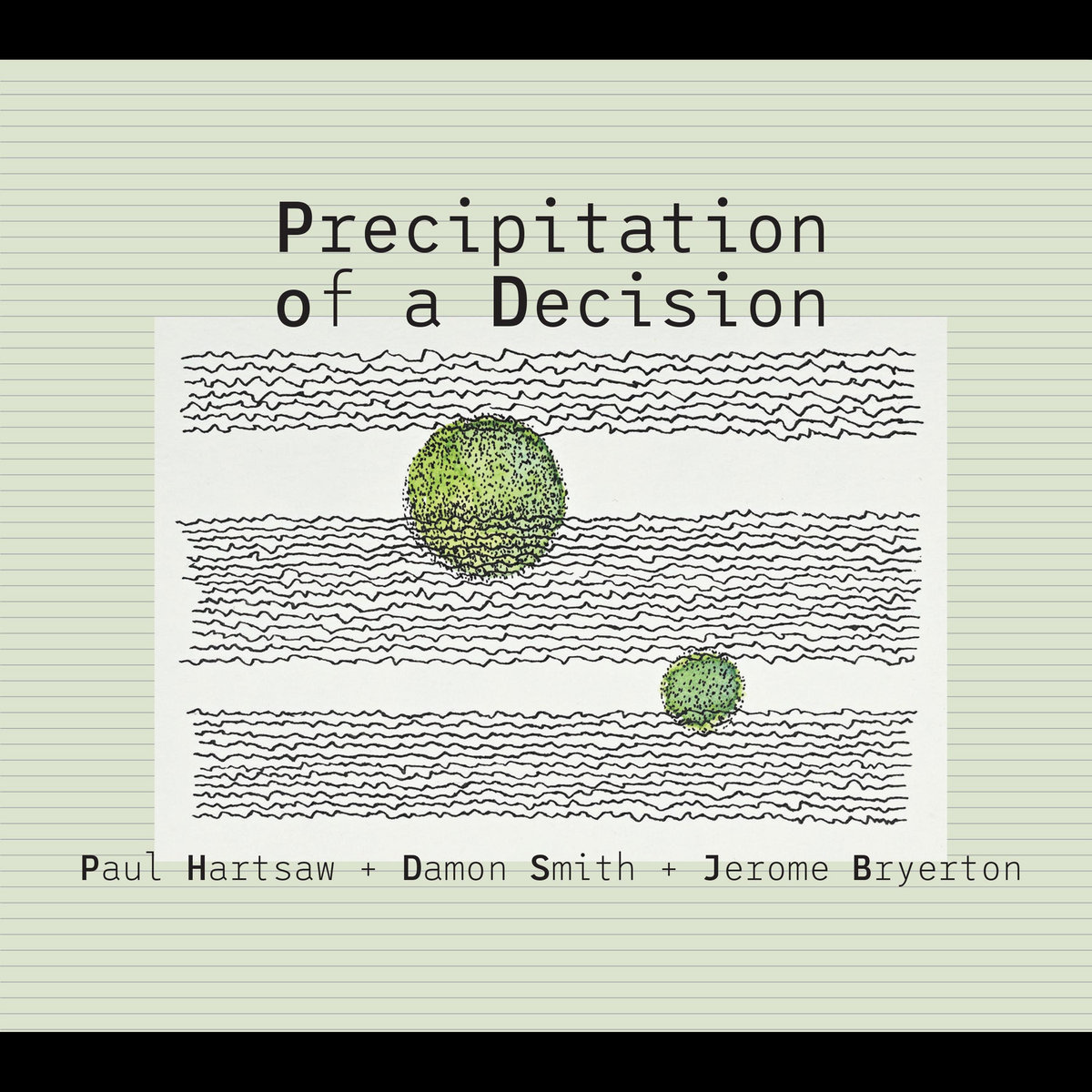
Precipitation of A Decision, The Ride on the 8 of Infinity, Paul Hartsaw, Damon Smith, Jerome Bryerton


There is something about music that is as good as one hoped it would be. It is reassuring? Consoling? There is also something interesting about how Free Improvisation can come to transcend the idea of the totally spontaneous when you hear it a fair number of times and it starts to make a meta-sense to you--in other words you understand it as a kind of deliberate form even though it is "off the cuff." I must report in, gladly,  that the album at hand today gives me both satisfactions. 

Precipitation of a Decision, The Ride on the 8 of Infinity (Balance Point Acoustics BPA 2CD3)  combines pn two CDs a 2008 session (Ride) with one from 2021 (Precipitation). Ride features Paul Hartsaw on soprano and tenor sax and Damon Smith on contrabass. Precipitation has Hartsaw on tenor only along with Damon Smith on contrabass and Jerome Bryerton on drums.

Both Paul Hartsaw and Damon Smith are artists I have been hearing and appreciating for some time. (Look up both in the search indexes both here and on the Gapplegate Guitar and Bass Blog for earlier reviews of albums by both artists.)

The trio album is especially invigorating, with wonderful three-way interfaces of dynamic freedom. The duo disk has especially intimate dialogues, not as full-out blowing energy exactly,  but then really quite subtle and absorbing in a slightly more esoteric way. Drummer Bryerton sounds lucid and open in the trio session. And the three get more dynamic and energetic at times.

It is all told some of the finest free jazz albums of the year thus far. It is after a few listens centered on the world that the players occupy and respond to, it goes perhaps without saying. But of course it is not THAT they respond so much as HOW they respond, that makes this special.

This one will certainly appeal to the Free Improvisation aficionados out there, as it is a specially fine example. It might also serve to introduce nicely those not familiar with the genre. Bravo!

Thursday, June 3, 2021

Ivo Perelman, Matthew Shipp, Special Edition Box


Over the past decade the various duet recordings between Ivo Perelman (tenor sax) and Matthew Shipp (piano) have unquestionably been some of the most advanced and together new Jazz-Free recordings of our time, a duet for the ages. Happily they continue to play together. Most rewardingly there is a Special Edition Box (SMP Records 2020) with more excellent music from the two. 

The box contains a studio CD of the duet entitled Procedural Language, a Blu-Ray of the duo Live in Sao Paulo at SESC, a video capturing them at said event on July 11, 2019. Then there is an informative booklet, Embrace of Souls by Jean-Michel Van Schouwburg.

I no longer have the capability to view Blu-Ray disks on any of my devices so I was not able to watch the DVD. I am sure it is worthy but I have not been able to check it out.

The booklet has an appreciation and chronology that puts the music in perspective, followed by an annotated discography of interest to any collector-enthusiast.

The whole package is quite handsome but it is the CD Procedural Language that grabs my attention especially and attracts my ears with each listen. There are twelve improvisational segments for Ivo's tenor and Matt's piano, every one a significant improvisational utterance, freely articulate and ever filled with a Jazz joyfulness. Ivo testifies, declares, while Matt responds with free structuring towers of pianism that beautifully open up the moment with great ideas that spur Ivo on all the more.

It is some of the most remarkable of their duets, which is saying a lot since we have been blessed with some real gem sessions from the two in the last five years. Tumbling, driving, contemplating, exclaiming, decrying, balladizing, harmo-melodic stratosphering, they spontaneously travel the musical spaceways in ways that ring true always. If you need rejuvenation (and nowadays who doesn't?) this music appears as an oasis in sometimes an all-too-arid wasteland of the everyday. Here are Ivo and Matt in the full maturity of where they are right now, savoring each moment of music filling the air, letting the interlocking ideas flow unhindered. for optimum constancy of "telling it."

Monday, February 22, 2016

Wadada Leo Smith & John Lindberg, Celestial Weather

Wadada Leo Smith is one of those few artists whose every release these days should be heard. That list of artists for me is small but his music, his trumpet playing and composing show us a creator who keeps getting better, deeper, never flagging, ever.

So though I am late in posting on this, his album of duets with long-time bassist associate John Lindberg is another essential listen. The album is entitled Celestial Weather (TUM 046). I can't remember hearing John Lindberg doing something I did not like, either, for that matter, so not surprisingly this one makes me smile.

The Finnish label TUM does its usual exemplary job with the audio and physical packaging.

And so the music....It is an hour of excellent things to hear. There are three multi-part numbers involved. The first, by Wadada, pays tribute to the wonderful bassist and human being from the AACM and especially the Art Ensemble of Chicago. "Malachi Favors Maghostut - A Monarch of Creative Music" does the late master honor. John's bass playing seems suitably puckish here and Leo plays something that Malachi would no doubt have loved to be a part of. Both fill the air with some fine, outgoing extroversions worthy of the tribute.

Next follows the two-some's collective five-part "Celestial Weather Suite." It is open-freedom music, each part named after an unusual weather event, "Cyclone," "Hurricane," etc. They explore various creative possibilities, each interacting sensitively and soulfully to the other. There is agitation, there is relative calm, but there is never a loss as to what to play.

The final is the two-part Lindberg piece "Feathers and Earth." As with the others the compositional element is so integrated into the improvising that it is not all that easy to separate the two, but here there is a head melody/motif beginning the second segment. What matters is the totality and that there is no denying. It is essential.

In the end we get inspired trumpet and bass playing, a duet far beyond the expected status quo, whatever that might be, and into some SERIOUS (Sirius) stellar explorations that while spontaneous as a whole are the product of two lifetimes of committed musical direction.

So of course I can only recommend this to you. It is celestial in the best sense. And the listening is nothing but pleasure.

Friday, December 11, 2015

Grego Applegate Edwards Talks About his New Two Volume Suite, Rust Belt

Once again I beg your forbearance as I use this blog space to talk about my latest music, Rust Belt I and Rust Belt II (Ruby Flower Records), which are now available at Amazon.com under Grego Applegate Edwards. As before the "discussion" takes the form of a phony interview of self with self.

Blogger Grego: What made you do this music?

Artist Grego: I guess that's a story in itself. In the past decade I've been doing a lot of reflecting on the area I live in (just outside of NYC on the Jersey side, a once thriving industrial zone) and where I grew up (west of this area in Jersey, just outside a major factory town, Butler). I was taught in college to look at how economic forces help shape the culture that exists in any area and time. I accepted the idea but did not feel it as directly as I have in recent years. Recently I've spent a fair amount of my time in Hackensack, NJ, a very old town that formed as many towns did on the edge of a body of water (the Hackensack River), mostly because of the possibility of shipping-based commerce. Nowadays the town has shown much evidence of the blight of rust belt transformation...seen in the ruins and re-purposing of factory buildings that still dot the landscape. It's no accident that an old Salvation Army headquarters still stands, though perhaps ironically now a real estate office. It was built in the '20s on the eve of the Great Depression, when the beginning of industrial decline first made a real appearance in the area.

Anyway it got me thinking of my early youth. Butler was at one point one of the world's centers for the manufacturing of rubber goods, with the Butler Rubber factory there a major producer of hard rubber items like Ace combs, bowling balls, etc. There was also until 1958 and its fatal destruction by fire the Pequonnock Rubber Reclamation Center--an industrial complex that received endless shipments of scrap rubber--old tires, etc--by rail and melted it all down to create sheets of rubber which then were purchased by rubber manufacturers to make new goods. Between the two of them, Butler employed thousands to work the factories. The entire area centered around the manufacturing of rubber goods economically and socially. My dad made his living selling rubber goods himself--o-rings. Most people in eastern Jersey existed because of manufacturing, one way or another.

When I was four years old I remember one of my first shopping trips to downtown Butler with my mom. It was a god awful inferno of the smells of melted rubber, the thick smoke and the loud industrial sounds coming from both factories, but it was then the principal shopping area, too. So I remember walking down the sidewalk on Main Street with the huge block of wall-to-wall rubber factories going full tilt and giving me a very nauseous feeling, yet on the right of me the many shops. I had ten cents in my pocket and entered the local five and ten--now long gone as are the two factories. That time in 1957 was the end of the road for 78-rpm records but they still could be found, and so in one big bin at the five and ten there was an assortment of cut-out 78 recordings that were on sale for nine cents each. As it turns out they had a Roulette 78 of Lambert, Hendricks and Ross with Count Basie doing "Jumpin at the Woodside" b/w "Rusty Dusty Blues." I bought that one because it looked interesting (mostly because of the visual design on the label) and it turned out it was my first jazz record in what ended up to be a very long line of them.

So thinking back I realized in the last several years that the record existed, that the 5 & 10 existed, we living there existed because of the backbone of industry that thrived all over the region. Without it, everything I did or did not directly experience would have not been possible in the form things took. No job for my father, no 5 & 10, no jazz players making a living, no network of clubs offering music to people, none of it would have existed as it did then.

And now the factories are gone, industry has moved elsewhere, the local 5 & 10 is long gone, the jobs people had for better or worse in industry have disappeared, and the clubs, the record industry that fully thrived on people having spending money for things like jazz recordings, all of it has disappeared in the form that I took for granted as a kid. And looking back in this decade I relived that process lasting some 50-60 years, the process of the making of the rust belt. There was a story there, there was the sound of the factories, the music the factories made possible, the sound of everyday industrial life punctuated by church bells on Sundays, school bells, factory bells, railroad crossing bells, all gradually fading in their own ways and their place taken by whatever it is that makes the Eastern US support a population now, built over a set of crumbling factory foundations, bowling balls, combs and all the other accretions of the local historical industrial world becoming buried in time and space.

That was how I entered into a long sort of aural and mental meditation that culminated in the music of Rust Belt. I pictured the house I live in at the moment, an old one, as no doubt a house occupied by factory workers in the mid-last century. How was it to live there then? I looked around at the changes, felt very directly the economic recession and wondered what it was this part of the US could do now to support the population. Will we all work at fast-food restaurants? Wal-Marts? How can we support life if this is our future?

So it was a period where I suddenly GOT IT--that feeling of time and change and the economics shifting and de-creating a huge complex of lifeways that was the industrial Eastern US. And it gave me sounds and musical ideas that would express the time then, the disappearance, the ghost town of empty or reused factory buildings and the ghosts of the lifeways and the people that toiled and somehow made a living, ate those pancakes and hamburgers, went to high school football games, shopped in the stores, celebrated the war victories or mourned the war dead, listened to radios and TVs that told them something about their lives, raised their kids, did the everyday things we now feel exist a little less and a little less.

By now we know it all changed or is changing and now its all about texting, cell phones, making cell phones in China and selling them here, a life all seemingly centered around those phones. I started feeling vividly all the differences between then and now, for good and ill. I wanted to make that into a musical suite, though at first when I started making the music I had that gotcha enlightenment but did not give name to the music it produced. Only later as I got into it did I see the relationship of the realization of time and process into its direct creative transformation. And then it all really came together. Or I hope it did, anyway!

Blogger Grego: All that as an introduction...I see. Do you always talk/write so much?

Artist Grego: No. But this whole complex of feelings and thoughts I also envision as a novel, where there's going to be even more words, so you should be grateful I don't just spring that on you!

Blogger Grego: OK, OK. So let us get to the music. I heard you mumbling the other day how the music contrasts bell sounds with rust silence. What is that about and how did that come about?

Artist Grego: The image in my head and the sounds that grew in my head have to do with the story--of how the music then filling the world mingled with the sounds of all kinds of bells and the sounds of industry. What I was hearing I set about intuitively to create. For this project it was very much an additive process. I started with bell sounds from various sources and started to manipulate them electro-acoustically. Once I had created some of that I went into the basement studio and tried out some things that might layer atop the sounds, so I grabbed my various guitars, keyboards, drums, percussion and bass guitars that had by then congealed as instruments of choice. One thing lead to another and after trial and error and lots of time playing, listening back and thinking, a suite began to take shape. There were bell sounds, both free and composed elements all falling into various sections. The free and new music elements took shape with a bunch of sections that dealt with rust belt locations, factory rhythms and human rhythms, the punctuation of all the time with bells, the life of the workers and residents centering around periods of work, rest and break time, the ghostly feeling of the loss of all of that and the silent sound of architectural and cultural ruins.

Blogger Grego: Why do you start with "Music on Mbuti Themes"?

Artist Grego: I can't rationally answer that. The Mbuti peoples of Central Africa make some extraordinarily beautiful music and at the same time as this rusty industrial buzz was playing out in my head, there was the contrasting elaborately primal beauty of the Mbuti music that seemed to flicker back and forth in my mind with the music of industry. We all come out of Africa, ultimately, and the Mbuti music symbolized a very different life that we all must have experienced in some way, that we all carry with us in the deep recesses of our DNA and our unconscious music minds. So that seemed like a way to begin--to go back to a beginning and then shoot forward to the industrial revolution, skipping agricultural byways I know, but kind of making a point about the industrial world and how it changed us all quite radically, while also musically giving us other things in response. So that I guess was why. But I just HEARD it as a starting point. I wasn't thinking then WHY I was doing it.

Blogger Grego: And then there are some sections that are more obviously rock oriented, psychedelic in ways.

Artist Grego: Yes--again that all just fell into place because I felt that the music contrasted, gave punctuation, that those passages were like time marking bells of their own, since that style of rock was a big part of my upbringing in this pre-rust world, too.

Blogger Grego: So you ended up with this two-volume suite of music. Is it supposed to show off your being able to play a bunch of instruments?

Artist Grego: No, not really. It has some leeway for just playing, yes, but in no way am I putting myself forward as a guitarist, a keyboardist, or an anything-ist. I play composer's instruments. It was a way to create an orchestral blanket of sounds, to think pretty carefully about sound colors and electric-acoustic blends that expressed the tolling of the bells and the coming of the rust. I hope that each section tells a sonic part of the story, which the song titles pretty much explain. It probably doesn't make sense to talk about the music much further, as the listening will I hope have a kind of narrative beyond my words.

Blogger Grego: "No Putt-Putt for Pop-Pop?"

Artist Grego: Well, yes, at the end Pop-Pop is unemployed, or can't have a car, or is making a hasty retirement from the work world, like it or not!

Blogger Grego: So these albums are out now?

Artist Grego: Yes, happily. I thank Ruby Flower records for putting them out and all who have encouraged me in the last rather tough year I've had. They are priced at $10 per volume, not to make money but to make the music available so that people can hear it. The Amazon link is http://www.amazon.com/s/ref=nb_sb_noss_2?url=search-alias%3Daps&field-keywords=Grego+Applegate+Edwards Copy and paste the url into your browser to get to that page.

Blogger Grego: Anything else you'd like to say?

Artist Grego: Sure, but I think I've said enough already. I humbly put this music out in the hope that it will express something of how I have felt over the last few years about how it is to live through huge changes in your world, OUR world, and what that might sound like. Thanks to everybody out there who reads my blogs and, I hope, might listen to my music, too!
Tuesday, November 10, 2015

Jon Irabagon, Inaction is an Action

Today a look at one more recent example of the music of Jon Irabagon, Inaction is an Action (Irabbagast 005). Where the previous releases were ensemble oriented, composition and improvisation based, this one is devoted entirely to solo sopranino sax improvisations in an avant-free jazz mode.

The emphasis is as much on sound color and timbre as it is on line, on expression as it is on form (form follows inventive content, in other words).

For this, his ninth outing as a leader, Jon roams freely onto pathways of personal self-expression that utilize technique, subvert it and create it anew in unusual ways of sounding the instrument.

The avant history of the sax is channeled and renewed Irabagon style. From Trane and Ayler to Lacy, Braxton and beyond, Jon assumes a level of sound innovation and adds to it. There are arabesques of line sounding that identify themselves as personal and original but also as coherent partly by means of the avant tradition. There are pure moments of sound, then some things equally line and sound oriented.

It's not just a matter of creating new sound-colors and creating melodic form both inside and outside those parameters; it is ultimately a series of cohesive sound-images organized and framed by the parameters of slices of time, selections, pieces, eight in all.

Jon most certainly dwells in rarified territory for this album, more extreme perhaps than most of his previously recorded work, but connected to the whole of his artistry in its keen attention to timbre elements. There is no "jazz" saxophonist out there today who does not work out of a personal set of timbral possibilities. Jon is no exception, yet he can unveil a wider set of sound-color extremes than many and appears to take delight in interjecting them during the course of his soloing. Here that tendency is taken much further than usual, with the unaccompanied solo format lending Jon an unlimited freedom he makes great use of.

And then when he turns to episodes that zero in on line extensions, as in "Ambiwinxtrous," he phrases in unusual melodic clusters, then in turn phrases the extended techniques that follow in their own way, combining clusters of tone and sound as part of a totality of phrased gesture.

In the end Jon pushes his own personal boundaries of the limits of expression further beyond what we ordinarily hear from him in recorded form. In so doing he again establishes himself as an important and breakthrough player in the avant sax mode. Perhaps he will treat us to some of this outside playing with an uncompromisingly out ensemble in future. If so I will certainly want to hear it.

In the meantime we have this unaccompanied flight to the nether worlds of expression. Jon is essential listening for what's going on today. He pushes the envelope especially and satisfyingly on Inaction is an Action. Danger, bare wires? No. No danger here. Just keenly insightful explorations.

Highly recommended.

Friday, October 9, 2015

Blaise Siwula, Carsten Radtke, Joe Hertenstein, Past the Future

I have been listening to and appreciating saxophonist Blaise Siwula for a pretty long time now. He is a central figure in the avant free jazz realm in New York City. I don't recall hearing him more inspired in recordings as he is on the new disk Past the Future (No Frills Music NFM 0008).

It is a three-way cooperative improvisational meeting of Blaise on alto, tenor and soprano, the electric guitar of Carsten Radtke, and the drums of Joe Hertenstein. And a fine confluence is made out of the excellent chemistry the three generate together.

Joe Hertenstein is a drummer of great sound color and smarts. He unleashes his timbre-ally diverse kit and puts it to the service of creating cohesive and moving panoramas of percussive logic. His playing lays an important foundation for what the trio freely creates.

Carsten Radtke gives us some very inventive guitar work that is as unpredictable as it is diversely astute. Chordal inventiveness goes with single-lining dexterity and sound manipulation for an impressive voice in the proceedings. And what he does stays in the mind and catapults the others to overtop the norm, launch into creative overdrive.

And Blaise Siwula? He is extraordinarily articulate, blazing with a big sound on tenor, plying equally well his agilely inventive alto and his puckish soprano. This trio gathering seems to especially inspire him to go beyond to the highest realm of creative saxophony. He invokes all of his avant chops for an expressive tour de force on this one. And you can hear in his playing here as elsewhere the entire history of jazz and avant as sonic reference points on the way to his own considerable immediacy and originality. If you want to know what Blaise is about, why he is an important stylist and innovator, seek no further. You can hear it in concentrated and explosive form on this, Past the Future. His tenor playing is not often in the limelight. He sounds very much at home on it here! So that is a welcome added bonus to it all.

Ultimately the point of it all is the threesomeness that is achieved in all glory on this session. Each member carves out of his creative and preparatory actions over the years a special trio sonance, an interactive virtuosity that really puts a burn in the retro-rockets to propel them to the musical heavens.

For a jazz-rooted avant freedom this is one of the finest sessions I've heard this year. Needless to say I do strongly recommend that you grab this album.

Wednesday, August 19, 2015

Universal Indians with Joe McPhee, Skullduggery

The teaming of avant titan Joe McPhee with the trio Universal Indians was an inspired idea that bears excellent fruit in the live 2014 Antwerp recording Skullduggery (Clean Feed 328). It is music with some of that classic "new thing" exuberance. It is music that Albert Ayler would have loved to be a part of!

McPhee is on saxes and pocket trumpet, John Dikeman on saxes. The two form an imposing front line with some beautifully in-your-face avant testifying. Jon Rune Strom on acoustic bass has a huge presence in the music both in the solo realm and in the ensemble. Totlef Ostvong's drumming is chargingly extroverted and always interesting.

The vehicles are collective compositions with some thematic guideposts now and again that may well be spontaneous but all the better for all that.

Both McPhee and Dikeman are in fine solo form and work in tandem together particularly well. It is great to hear Joe stretch out in flat-out free context. Truly this is a kinetic four-way blow out, infectiously forward moving and ecstatically satisfying for those who move on the free-way of uninhibited expression.

A fabulously out set! Need I say more?

Wednesday, August 12, 2015

From Wolves to Whales, Wooley, Rempis, Niggenkemper, Corsano

With From Wolves to Whales (Aerophonic 007) we have an all-star avant jazz lineup creating a program of vibrant free sounds. Nate Wooley plays trumpet, Dave Rempis sticks to the alto sax, Pascal Niggenkemper is on acoustic bass, and Chris Corsano provides the drumming.

Each artist has made a name for himself on his respective instrument and the four create lively sonic tapestries with five collective improvisations. What strikes me about this date is the sound event variables they carefully and sensitively evoke. For example the opening "Slake" features moments where with various conventional and extended techniques the group dwells in quietly upper register tones nicely for several episodes.

"Serpent's Tooth" begins with malleted toms and a bass motive freely articulated against the alto playing patterns repeatedly, then muted trumpet enters with long tones and on from there.

In short there is freedom, there is energy but there is also a structured use of what you might call role-playing among the four at strategic points.

The innovative interactions pay off with a program that has aesthetic variety as well as free expressive impact.

In the process all four come across with their stylistic individuality and yet form true cohesion as a quartet.

It's a very good listen and another excellent release from Rempis and his Aerophonic label.

Friday, August 7, 2015

Open Field + Burton Greene, Flower Stalk

Not all so-called "free" music is alike. Anyone who listens to it extensively knows that. Just like not all Indo-Pak classical is alike. So Open Field + Burton Greene and their beautiful Flower Stalk (Cipsella 002) is by no means quite like any other album in the avant improvisation realm. Why is that?

Burton Greene is an integral part of this music. He is virtually an avant institution, a pianist soundsmith with extraordinarily open ears and a superb sense of what to play and when to play it. He fills a key role here on piano and prepared piano. Open Field joins Burton on this album. It is a Portuguese-based trio of Jose Miguel Pereira on double bass, Joao Camoes on viola, mey and percussion, and Marcelo dos Reis is on nylon string guitar, prepared guitar and voice.

The drummerless quartet enters into chamber jazz territory that has a new music spaciousness to it, a sensitivity to part playing and sound color. All work together in pretty profound ways to get some immediate and vibrant ensemble combinations that vary dramatically in mood but create layers of invention that stand out.

There is no idling or preparatory runs on this one. All five pieces are filled with significant totalities where each instrumental part has its own special presence yet the working out of the ensemble as a whole gives the listener a poignant unity.

It's a beauty. The album is in limited edition release so get this one while you can. Kudos! Collective improvisations of excellence are here to be appreciated!

Thursday, July 30, 2015

Francois Carrier, Michel Lambert, iO

The alto saxophone of Francois Carrier and the drums of Michel Lambert have formed an excellent tandem for some time now, as an entity in itself and as a core nucleus that adds sympathetic others as fitting. You can look up Carrier's various releases with Lambert that I've covered on these pages by typing Francois' name in the search box above. It has been and is an association that bears much excellent free jazz fruit.

Now we have a new duo recording of the two that productively documents the ongoing collaboration with iO (FMR CD 384). It comprises nine open improvisations that feature Lambert on drums and Carrier on alto sax and Chinese oboe.

The music was recorded live at two different venues in Montreal in 2012 and 2013. On both occasions the two are in great form. They explore the terrain they are known to do, free, open improv with expressive torque and spontaneity.

Carrier is fast becoming one of the very premiere alto sax voices out there in freedomland, with a beautifully lucid sense of line and sound. Lambert is his perfect foil, so to say, with a creative brilliance of his own.

Together they make magic here. If you like the open world of the intimate duet on the new improv scene, this is one you'll no doubt thoroughly enjoy. Carrier and Lambert have much to say and they say it!

Monday, January 26, 2015

Ascent of the Nether Creatures, Rashied al Akbar, Muhammad Ali, Earl Cross, Idris Ackamoor

One of the nice things about reviewing is that you get to check out things you might not otherwise have the chance to hear. And of course what seems worthwhile I pass along to you, the reader. Such a rather obscure but nice album is the 1980 Netherlands club date of the quartet of Earl Cross, trumpet, Idris Ackamoor, alto and tenor, Rashied al Akbar on bass, and Muhammad Ali, drums. They gather together their collective forces for a very fire-y freebop set on Ascent of the Nether Creatures (No Busines LP 78). It is one of those limited edition vinyl releases that No Business does so well, and it is a good one.

The sound is not entirely perfect yet very clear. The music makes up for what is very slightly less than pristine sound. Cross and Ackamoor make excellent front-line soloists and have it all together on this set. Akbar is doing good things on bass. And as might be expected of Muhammad Ali (late brother of Rashied Ali), the drumming is expansive and very swinging.

They do four originals that have contrast and plenty of room for free blowing. And they come through. These are players that have not gotten near enough credit for their contributions to new thing freedom. A careful listen to this record tells you why that should not be the case.

It captures a period when free jazz was still new enough that the thrill and even ecstasy of letting it all go to the rafters was still there. There is no reason why that should not still be the case but there seems less of it now. Listen to this one and recapture some of that thrill!

Friday, January 23, 2015

Red Trio & Mattias Stahl, North and the Red Stream

The world of free avant music, sometimes called "free jazz," continually evolves and permutes so that a simple classification of style sets doesn't always serve to clarify. Potentially every configuration of players occupies its own world, though of course that is never entirely true, since both the past and the present influence every soloist and ensemble in some way.

But nonetheless the idea that every moment of music-making is potentially open to any expression allows at least theoretically for anything to develop. The feeling of open creativity in spontaneity has been very present in the best senses with the Red Trio, a worthy gathering of pianist Rodrigo Pinheiro, contrabassist Hernani Faustino and drummer Gabriel Ferrandini. On their latest recorded outing they add vibist Mattias Stahl. With his presence there is a four-way dynamic that shows both continuity and change; his inclusion is a factor that gives the group dynamic another melodic-harmonic voice that brings a freshened set of spontaneous sounds to bear.

All this on the CD North and the Red Stream (No Business NBCD 69). It was recorded live at the VDU Jazz Festival Kaunas late in 2013. And no doubt the live gig gave them some additional inspiration because they are all locked into good things throughout.

Both the pianist and the vibist have in jazz and subsequent avant music been historically faced with dual poles of consideration. Both instruments, at least in their maturity, have the capability of creating self-sufficient harmonic-melodic worlds, yet of course in a group context and as influenced by the development of the music there has been the pull to create horn-like lines. Earl Hines was one of the more overt of the early exponents of the horn-style of soloing, but of course he never abandoned the two-handed harmonic pianism that came naturally to those who study the instrument. With the history of vibes playing it was later Red Norvo and of course Milt Jackson who did more to integrate that pianistic harmonic conception into the vibe approach. Since then both instruments variously gravitated between lining and harmonizing as the music evolved and changed.

I bring this up because Pinheiro and Stahl do a great job on this set travelling in and out from a harmonic to a lining approach. In a free context where there are implied key centers but lots of freedom of choice, the two players work especially well together in choosing lines and harmonic voicings. And by so doing you get a distinct kind of spontaneous fullness that Hernani on bass responds to rather brilliantly and Gabriel absorbs and in turn sets up various inventive pitched and unpitched washes of percussion.

And that is to say that the group sound as a four-fold voice is especially prominent and innovatively interesting on this set. That is not to say that there aren't solos here. But the solos are quite often integrated into four-way dialogue where everyone adds to the solo for a very creative ensemble sound.

These are four very talented creative souls and the freedom they espouse is extraordinarily well developed on this set. It is a set that sustains interest from start to finish. There are no tentative sounding harrumphs, no momentary fumblings for direction. They know what they are about and they go there, directly, and stay there.

And the vibes-piano tandem works especially well. That's because they, and really all four are listening--but complementing more so than simply responding to each other.

It's a very, very good outing that all interested in the free zone should hear.

Monday, December 1, 2014

Trio 3 & Vijay Ayer, Wiring, with Oliver Lake, Reggie Workman, Andrew Cyrille

There are master jazzmen, avant or otherwise, who as they mature gain a depth to every note they sound, just about, and an impeccable feel to whatever they do. Such a three are certainly Oliver Lake (alto sax), Reggie Workman (bass) and Andrew Cyrille (drums). Their incorporation as Trio 3 is more than just a great idea, it is a band with a certain monumentality about it. Each excels as a master of their instrument; each has a musical sensibility that years of open playing have made possible--but of course only with the work of titans such as these. And each works together to get an interplay far above "avant business as usual."

So when they team up with a guest who is younger yet most definitely on the track to an open profundity, expect some real kinetic synergy. Such is the case with the teaming of pianist Vijay Iyer and Trio 3 on the album Wiring (Intakt 233).

There are compositions by all and one by the very undersung Curtis Clark. A high point is Vijay's "Suite for Trayvon (and Thousands More)," which underscores the series of brutal and very questionable shootings of Afro-Americans by those in law enforcement made only too real this past week by a "no indictment" decision in another case. A sense of outrage is put into music. And I hope it will help the collectivity out there come to grips with the facts and demand reforms. Period....Question mark.

But this album lays it all out to give us great playing from start to finish. Iyer fits right in and they get from the quartet a classic sort of freedom of expression that has in it the essence of the very best from times past. Trio 3 were a part of those earlier days, an important part, so it does not surprise. It confirms.

Yet one cannot predict what a meeting such as this will bring about. Iyer and the three hit it off strikingly well. They make a set that ANYONE with an interest in the new jazz should hear. Something of an instant masterpiece is what this is. Only of course to make music of this depth and power takes the collective work and experience of many years!

Don't miss it!

Monday, November 3, 2014

Frank Lowe Quartet, Outloud, 1974

After his first album Black Beings came out (see February 2010 review at http://gapplegateguitar.blogspot.com/search?q=black+beings for my take on that), Frank Lowe went back into the studios, this time with Joseph Bowie on trombone, William Parker on bass, and Steve Reid at the drums. It was May 1, 1974 and "loft jazz" was at a peak in New York. The tracks recorded then were intended as Lowe's second but instead his label at the time had him return to the studios to record what became Fresh, a different sort of album altogether.

Happily for us the real second album, Outloud (Triple Point 209), is now available in a state-of-the-art 2-LP set that includes the welcome bonus of the group at Rivbea for the second LP.

After the two-tenor (Lowe and Joseph Jarman) onslaught of Black Beings this was a slightly less dense outing. Outloud gives us Lowe as the sole tenor. He is inspired to create a mix of testifying outbursts and some passages of more openly melodic improvisations that show a slight influence of Archie Shepp but as an inspiration, not as a copy. It is all Lowe. William Parker is truly on fire on bass. His playing is exemplary in every sense. Steve Reid stokes the fire with driving drums. Joseph Bowie is at his raucous and inventive best. The Frank Lowe compositions are excellent vehicles and set the table for a great improvisatory meal of sound, so to speak.

This is a heretofore unknown new thing loft era avant jazz classic. The Rivbea session, captured sometime soon after with Rashied Ali as engineer-recordist adds to our full appreciation of that band. The music is just slightly more dense. Trumpeter Ahmed Abdullah joins the group for the final side and gives us all that makes him the great improviser he is.

The accompanying booklet is excellent. This is what a (new) reissue should be: beautiful pressings, great graphics and superior music in all senses. Very much recommended.

Tuesday, October 7, 2014

Fred Tompkins, Flute Settings

Last month we took a look at Fred Tompkins' classically tinged jazz composition as recorded in the late '60s-early '70s by a stellar lineup of jazz all-stars (Fanfare 8, see post for September 4th, 2014). Today we jump ahead to the present, 2012 to be exact, and a recording of Fred Tompkins' recent work, Flute Settings (self released).

To draw comparisons with Fanfare 8 would not be quite fair. That record involved carefully conceived compositions recorded over a period of years. This album has good compositional elements--four by Fred, one a free collaborative improv with pianist Jim Hegarty, one by Hegarty himself, one by Boyd F. Becker-Nunley who plays steel pan on the number, and Ornette's "Lonely Woman".

As one can understand from the title the album is a showcase for Fred Tompkin's flute playing which is warm, lyrical, nuanced and open. He is not quite an Eric Dolphy in terms of technique, nor does he try to be. But he is quite effective and compelling in the solo role. The music ranges from Fred's work with flute and samples ("Voices") that plus the addition of Charlie Dent on drums ("Con Moto 3"), duets with Hegarty on piano ("Lonely Woman", "Melody" and "Free Form"), solo flute ("Solo Extensions"), and two different quintets, one with Becker-Nunley and a second steel pan voice ("Tabanca Time") and the final number ("Islands") with reeds, piano, guitar, and drums joining Fred.

This is generally a looser, more openly jazz-oriented date, some of it free form, others more arranged.

The compositional side of Tompkins (and others) can be heard to good effect but in other ways it is a more improvisational approach that prevails.

Nonetheless there is much in the way of thoughtful music to be heard, good flute presence and an open attitude that for its sincere straightforwardness has much charm and listenability. And it's great to hear that Fred is still at it, making very good music.

Recommended.

Wednesday, August 20, 2014

Kidd Jordan, Alvin Fielder, Peter Kowald, Trio and Duo in New Orleans

Three masters of improvised freedom gathered together for the first and only time--in New Orleans, April, 2002. The results form the first half of the 2-CD set Trio and Duo in New Orleans (No Business NBCD 64-65). Kidd Jordon on tenor, Alvin Fielder, drums, and the late Peter Kowald, bass--that's the lineup. And make beautiful music together they did. Mindful of both the past tradition of their art and the potential on the horizon, the free and clear way ahead, they perform as you might hope they would, open to the opportunity to express a significant three-way dialog.

Kidd and Alvin are no strangers to one another as co-members of the Improvisation Arts Ensemble in the '70s, but the time intervening has given them a maturity and even closer rapport without losing the fire and spontaneity of youth. Peter rises with them to the occasion for a marvelous set.

Three years later Fielder and Jordan recorded again, this time as a duet. The resultant set is in every way as good as the trio outing, perhaps even more urgently fired-up.

We all would do well to study these disks, for they contain a summing up statement of where they were at that point in time. For Peter near the end point of his journey, a salute to the excitement of being there with Jordan and Fielder, for the other two a new affirmation of the expressive power the music holds for us.

Beautiful release! Highly recommended.

Thursday, August 7, 2014

Darius Jones, Matthew Shipp, Cosmic Leider: The Darkseid Recital

You take two players of real breadth, stature, improvisational genious maybe, and you put them together. What will be the result? Sometimes you can't be sure the two will mesh. That's not the case today. Take the rolling-and-tumbling all-over-the-piano ballet of Matthew Shipp and put him with and against the starkly purposive alto of Darius Jones. You get Cosmic Lieder: The Darkseid Recital (AUM Fidelity 088).

It's from a couple of different live get-togethers recorded between 2011-13. It amazes, if I might suggest, with its bold give-and-take. This is free improvisation of the best sort. When Matt asserts a way through the open field, Darius counters with his own way, and both work together beautifully. Now that would be great whatever the content, pretty much, but what excites is the wealth of invention involved. Structure gets into the picture, the structure of the moment, but not just any moment. It's moment-ful as it is event-ful. There are spontaneous musical events that occur one after the other and each is in its own way a surprise, and each in every given segment works with the segments before and after to form a complete statement.

Now maybe that's easy to say but it's true of the music here throughout. You listen closely, you hear how it all works together and you revel in it. The best free music has something to say and, if everything is right, says it with consistency, with excitement, with an inner presence. That's what this set does.

Matthew Shipp is an institution among avant-free pianists today. He's paid the dues and he's surmounted the obstacles to forge a playing style that belongs to himself alone and he comes through, here as elsewhere, as one of THE CREATORS. Darius Jones may not be as well-known. But he too has that something here, that one-to-one thought-to-execution lucidity. His soulful abrasiveness and intensive line creativity complements what Shipp is doing excellently.

So that is what I feel after a good number of listens. If somebody wanted to know what is going on in the free-avant sectors right now, I would recommend she/he listen to this, among some select others, to get it. That's how strong I think this set is. Strength. It's here.

Oh, this release has an official street date of August 12th. But you can order it now direct from AUM, and/or you can pre-order a download version from i-tunes.

Tuesday, August 5, 2014

Farmers By Nature, Love and Ghosts, Gerald Cleaver, William Parker, Craig Taborn

Love and Ghosts (AUM Fidelity 089/90) constitutes the latest, third album by Farmers By Nature, the name given the trio of Gerald Cleaver (drums), William Parker (contrabass) and Craig Taborn (piano). It is officially on the streets August 12th but you can order it now directly from the label.

I don't believe I've heard the first two albums, but I can say that this double live set is some of the finest avant piano trio music I've heard so far this year.

What's so impressive is the wide variety of territories and moods the trio covers. They can get inside themselves collectively and give out with some very inner musings, they can worry phrases until they become cosmic otherness, and they can scorch you with some heavy statements of transcendence.

The remarkable interplay of three equal partners makes for music that rivets. William Parker is lucid and supercharged with ideas; Gerald Cleaver plays with an aural awareness most drummers don't get near; and Craig Taborn never sounded better on piano, hiply chordal, melodically alive, tumbling into open zones without a safety net, taking risks that pay off every time, locking into patterns that develop and set the stage for a further ripping apart of the heavens.

Seriously this one blows you away. Two full CDs of live trio and they never flag while giving your ears much to digest and dig.

This is a holy grail of free music in many ways. It's one excellent example of what a free-avant piano trio can do when all members are gifted and inspired.

Just get it!

Monday, August 4, 2014

Akira Sakata, Giovanni di Domenico, Iruman

One cannot be everywhere at once, ear-wise or otherwise. The result is that I am guilty of paying insufficient attention to Japanese reedman Akira Sakata over the years. I am catching up though (type his name in the search box for two previous postings), and as luck would have it I received a copy of his recent disk with pianist Giovanni di Domenico, Iruman (Mbari 21).

I am very glad I did. This is a 40-something minute get together of the two that shows an avant sensitivity and a synthesis of Japanese roots and international expression. Akira plays alto, clarinet, and vocalizes a bit while Giovanni plays a centered outness on piano that suits well Akira's brightly explosive outbursts between seas of calm-tone contrasts.

Akira sounds excellent on both alto and clarinet. Giovanni has lots of avant fullness that comes through and plays off of Sakira's well-conceived reed spontaneity. They run a gamut of expression here and do so with long-form and miniaturist monumentality.

It's an excellent outing!

Friday, August 1, 2014

Rodrigo Amado Motion Trio & Peter Evans, Live in Lisbon

Today we revel a bit in the second volume of the meeting of trumpet firebrand Peter Evans and tenormaster Rodrigo Amado and his Motion Trio, Live in Lisbon (No Business NBLP 75). The first, a CD, I posted on last month, July 10th to be exact.

The companion album up today takes on the LP/Vinyl format in a limited edition of 300. It's a live set with plenty of the torque of the companion volume. Peter on trumpet, Rodrigo, tenor sax, with Miguel Mira, cello, and Gabriel Ferrandini, drums, show you they aren't about to let up anytime soon. Perhaps never! In an infinite incandescence? Anything is possible and as long as I could stay around and dig it, why not?

Seriously though this one gives you hot blasts of freedom and quiet gusts of playfulness in proportion and balance, the quiet affording a change of pace, then more heat! Everybody shows what they are made of, with of course Rodrigo and Peter sculpting sound brilliantly with no let up on note choice. Miguel and Gabriel give you a special sort of rhythm section that springs forward and falls back definitively and dynamically.

Peter seems in an especially puckish mood with full use of sound color. Rodrigo follows up and comes back with some torrid heat that puts everyone over the top. Amado and Evans are some of the very finest practitioners in avant improvising today and Live in Lisbon gives you more reasons why.

This album won't be around long at 300 copies so I'd get it quickly if I didn't already have it. But the CD reviewed last month is especially essential so...really you might do well with both!! That's what I'd recommend.

It's an important go-round for this quartet. I hope they get together again soon, because they have chemistry in abundance and really rise to the occasion of intersection.

Highly recommended!